- Home
- ISLAMIC RESISTANCE
- SECRETARY-GENERAL
-
Full Speeches
- Speeches-2000
- Speeches-2006
- Speeches-2007
- Speeches-2008
- Speeches-2009
- Speeches-2010
- Speeches-2011
- Speeches-2012
- Speeches-2013
- Speeches-2014
- Speeches-2015
- Speeches-2016
- Speeches-2017
- Speeches-2018
- Speeches-2019
- Speeches-2020
- Speeches-2021
- Speeches-2022
- Speeches-2023
- Speeches-2024
- Speeches-2025
- Speeches-2026
- Speech-Reports
- SG
-
Full Speeches
- Voices
- Ten Day Dawn
- The Biggest Crime
- Martyr Leaders

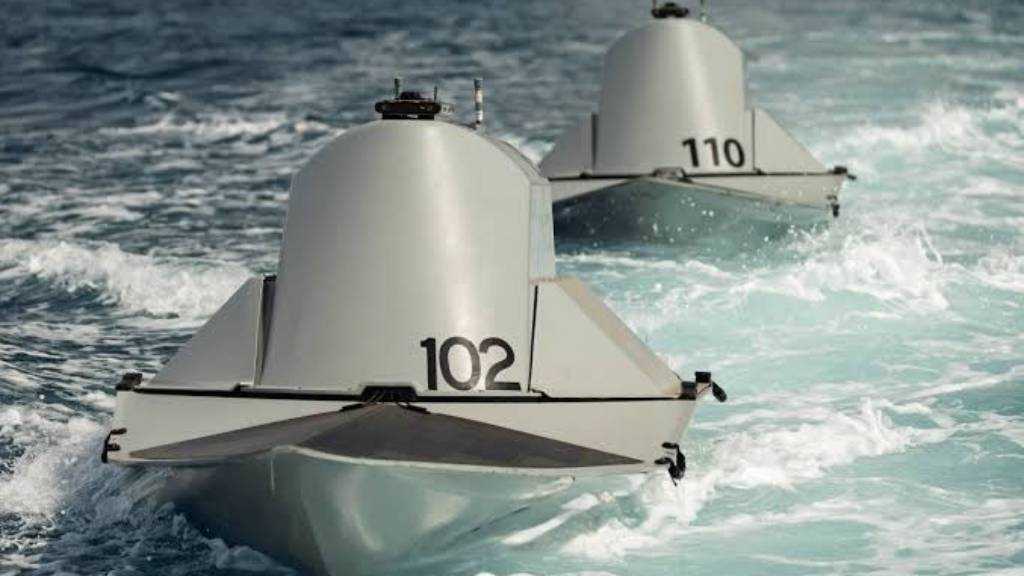
Pentagon Seeks Drone-Armed Robot Boats For Future Maritime Warfare
By Staff, Agencies
The Pentagon is seeking rapidly deployable unmanned surface vessels armed with attack drones as Washington looks for lower-cost ways to counter small boats and aerial threats in contested maritime areas.
The US Department of War has launched the SWAP-USV program, overseen by the Defense Innovation Unit [DIU], calling for autonomous boats integrated with at least two commercially available drones capable of detecting, tracking and engaging hostile targets. Companies have until August 10 to submit proposals.
According to the solicitation, the Pentagon aims to reduce its dependence on costly naval and aviation platforms for intercepting inexpensive asymmetric threats, arguing that the current cost of countering such targets heavily favors adversaries.
The solicitation said that the US military could not continue relying “on exquisite, multi-million-dollar naval and aviation assets to intercept these inexpensive targets.”
The proposed vessels would carry drones capable of reconnaissance, communications support, electronic warfare, payload delivery and precision strikes against moving or stationary targets. Together, the drones must be able to carry a kinetic payload of at least two kilograms, with both reusable and one-way attack drones under consideration.
Additionally, the systems must be easily transportable by cargo containers, road trailers or C-17 and C-130 military aircraft, while launch capability from remote or improvised locations is considered an advantage.
The Pentagon also requires all platforms to be technically mature and already in production.
The robot boats are expected to autonomously patrol maritime zones, detect and intercept suspicious vessels, including fast boats and semi-submersibles, while minimizing operational costs and personnel requirements.
They may also be capable of independently shadowing or intercepting non-cooperative vessels.
The year-long competition carries $100 million in prize funding across three development phases, with companies that complete testing potentially qualifying for procurement contracts backed by an additional $200 million.
The first phase, scheduled to begin in fall 2026, aims to field operational systems within 120 days, followed by more advanced testing phases through 2027.
Comments
- Related News