Tehran Hosts Islamic Unity Conference as Cleric Warns Against US-“Israeli” Regional Agenda
By Staff, Agencies
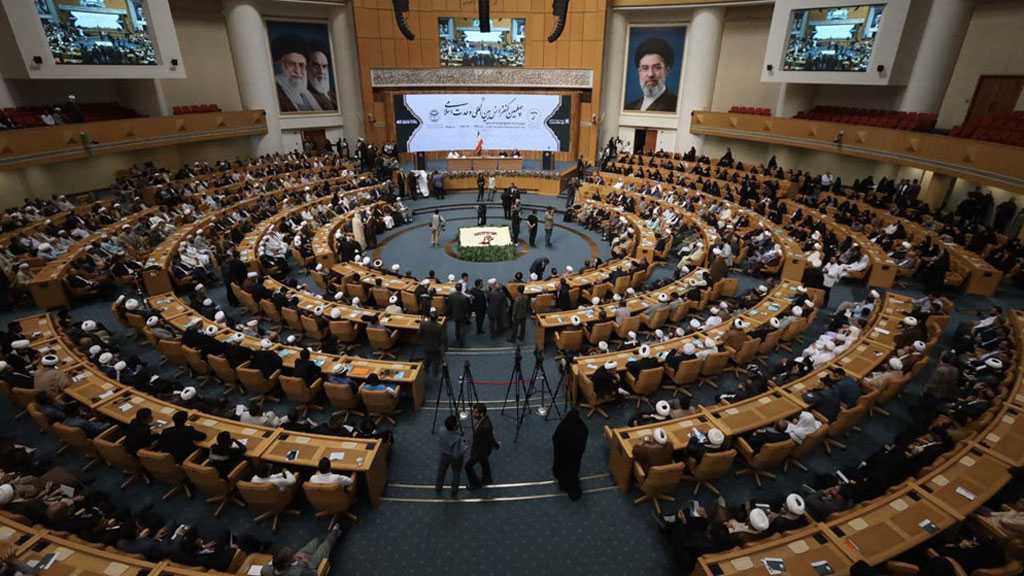
The 40th International Conference on Islamic Unity opened in Tehran on Thursday, August 27, 2026, bringing together Iranian officials, Muslim scholars and intellectuals from around the world to discuss strengthening unity across the Muslim world.
Iranian President Masoud Pezeshkian and hundreds of scholars and thinkers from around 40 countries attended the opening ceremony. Nearly 600 Iranian and international guests, including religious, academic and cultural figures from Iraq, Pakistan, Turkey, Lebanon, Afghanistan and the Gulf states, as well as ambassadors based in Tehran, were present.
Held under the theme “Islamic Unity in the Thought of the Martyred Imam, Ayatollah Seyyed Ali Hosseini Khamenei,” the conference focuses on strengthening solidarity among Muslims, encouraging cooperation among scholars and bridging intellectual and cultural perspectives across the Muslim world.
In a message to the conference, senior Iranian cleric Ayatollah Hossein Noori Hamedani stressed that Muslim unity was both a historical necessity and a religious obligation, particularly at a time when, he said, the enemies of Islam were attempting to divide Muslim societies and exert control over their countries.
Citing the Holy Quran, Noori Hamedani called on Muslims to remain united while emphasizing that Islamic unity does not require followers of different schools of thought to abandon their principles. He said scholarly disagreements should remain within academic and religious debate and must not turn into hostility, accusations of apostasy or violence among Muslims.
The senior cleric also warned that religious and sectarian differences should not be allowed to become tools exploited by the enemies of the Muslim world.
Pointing specifically to the United States and “Israel,” Noori Hamedani said the two were leading efforts to weaken Muslim countries. He rejected the idea that Washington and “Israel” were pursuing separate regional objectives, arguing that developments in recent years indicated a shared aim of maintaining regional dominance and preventing Muslim countries from becoming stronger and more independent.
He also dismissed the notion that US-“Israeli” hostility is directed exclusively toward Iran, describing such an assessment as overly simplistic. According to the cleric, any powerful Muslim country seeking independence and refusing foreign domination could eventually face similar pressure.
Noori Hamedani urged governments across the region to recognize what he described as the broader threat posed by “Israel” to independent Muslim states. He warned that while the Islamic Republic of Iran is currently the target of such hostility, other Muslim countries pursuing greater independence and strength could face similar pressure in the future.
He further called for Muslims to reject division, saying that actions or statements that deepen divisions within the Muslim community ultimately serve the interests of those seeking to weaken it.
Conference participants are expected to discuss practical measures for advancing Islamic unity, strengthening the concept of a unified Muslim community and addressing challenges confronting Muslim nations.
The conference coincides with Islamic Unity Week, which is observed between the different dates on which Sunni and Shia Muslims commemorate the birth anniversary of Prophet Mohammad [PBUH]. For Shia Muslims, the anniversary falls on the 17th of Rabi Al-Awwal, August 30 this year, while Sunni Muslims mark it on the 12th of Rabi al-Awwal, which fell on August 25.
The period between the two dates has been observed as Islamic Unity Week since the 1980s, following a declaration by Imam Khomeini, the founder of the Islamic Republic of Iran.