- Home
- ISLAMIC RESISTANCE
- SECRETARY-GENERAL
-
Full Speeches
- Speeches-2000
- Speeches-2006
- Speeches-2007
- Speeches-2008
- Speeches-2009
- Speeches-2010
- Speeches-2011
- Speeches-2012
- Speeches-2013
- Speeches-2014
- Speeches-2015
- Speeches-2016
- Speeches-2017
- Speeches-2018
- Speeches-2019
- Speeches-2020
- Speeches-2021
- Speeches-2022
- Speeches-2023
- Speeches-2024
- Speeches-2025
- Speeches-2026
- Speech-Reports
- SG
-
Full Speeches
- Voices
- Ten Day Dawn
- The Biggest Crime
- Martyr Leaders

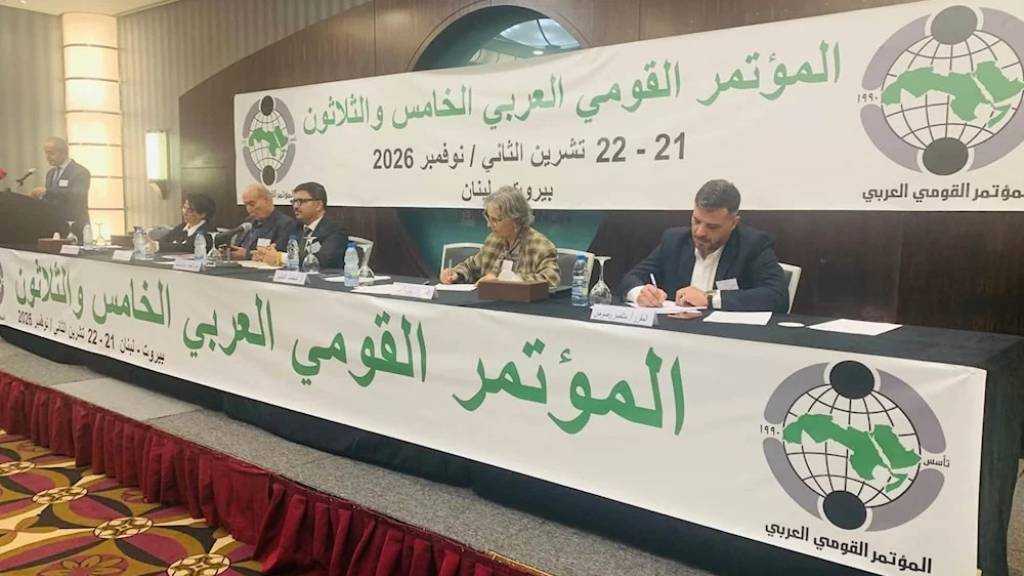
35th Arab Congress Ends Beirut Session with Call for Unity, Resistance
By Staff, Agencies
The 35th session of the Arab National Congress [ANC] concluded in Beirut on Sunday, bringing together around 200 political figures, intellectuals, and activists from across the Arab world and the diaspora for two days of discussions on Arab unity, regional developments, and the role of Resistance movements.
The closing sessions focused on Palestine and Resistance strategies, with Lebanese analyst Nasser Qandil chairing a panel featuring Abdel Halim Fadlallah, head of Beirut's Consultative Center for Studies and Documentation, and Hamas official Ali Baraka.
Discussions addressed Resistance to the Zionist project and the need to support Lebanon's sovereignty and reconstruction, reject Palestinian displacement, and advance Palestinian national dialogue.
Participants also examined the Arab Renaissance Project, emphasizing unity, independent development, social justice, and democracy.
Former Egyptian politician Hamdeen Sabahi stressed that the struggle extends beyond armed confrontation to the battle over awareness, while calling for structured Arab dialogue with Iran and Turkey.
Former ANC Secretary-General Maan Bashour highlighted the significance of hosting the gathering in Beirut on the occasion of Lebanon's Independence Day, linking genuine independence to Resisting foreign hegemony and pursuing democratic and social reforms.
Palestinian thinker Munir Shafiq warned that any ceasefire should not be viewed as the end of the war, arguing that "Israel" could seek politically what it failed to achieve through war. He also stressed that supporting Gaza remains a collective Arab and Islamic responsibility.
During the opening session, ANC Secretary-General Maher Al-Taher praised Palestinian resilience and the impact of Operation Al-Aqsa Flood in restoring the Palestinian cause to global attention, while warning against displacement plans targeting Gaza and the West Bank.
Hamas Political Bureau member Khalil Al-Hayya reaffirmed the movement's commitment to Resistance, while Hezbollah's head of Arab and International Relations, Ammar Al-Mousawi, stressed that Lebanon's sovereignty depends on preserving its defensive capabilities.
The gathering concluded with renewed calls for Arab unity, popular mobilization, and the political and financial independence of regional movements.
Comments
- Related News