From Student to Student: Lending Libraries Ease the Cost of Schoolbooks
By Staff
With each new school year, the rising cost of education once again weighs heavily on Lebanese families—from tuition fees to textbooks, stationery, and transportation costs. Even the most basic educational supplies have become a financial burden that many households can no longer afford.
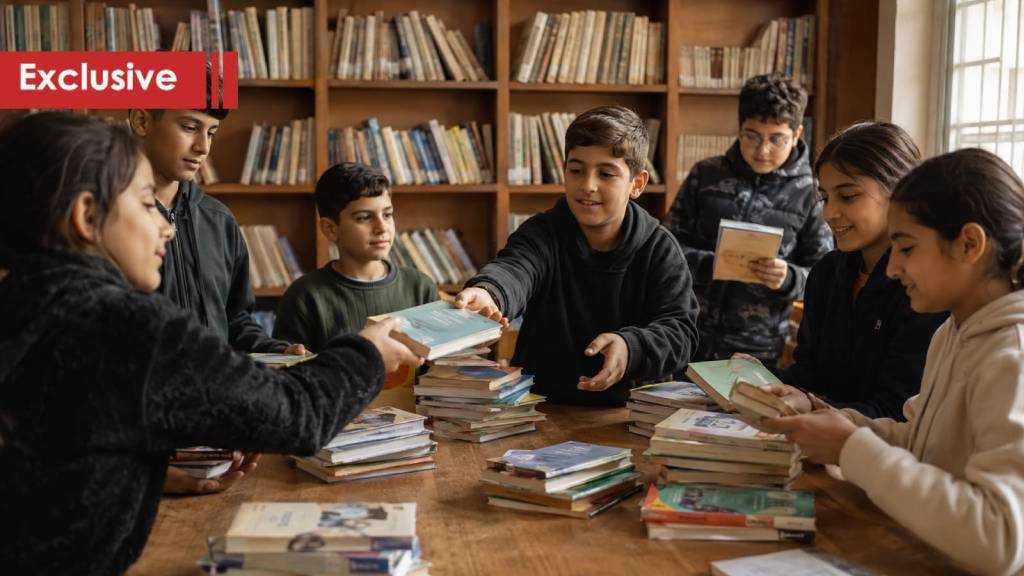
In response to these financial pressures, solutions are not limited to direct aid. Community-led initiatives centered on solidarity and resource-sharing are also gaining ground, including schoolbook lending libraries, which turn textbooks from a costly burden on families into a shared resource passed from one student to another.
In Beirut, the initiative is expanding through a network of libraries and centers that collect, sort, and make textbooks available to students. The effort extends beyond the centers run by the Educational Mobilization, with individual and community-led initiatives complementing the work, alongside contributions from scouts, women’s groups, teachers, and parents.
Osama Nassereddine, head of the Educational Mobilization in Beirut, told Al Ahed News that the schoolbook-lending initiative has continued to expand year after year. In recent days, he said, new libraries have opened at the Imam al-Askari Complex in Kafaat, in the Ouzai area, and at the Imam al-Baqir Complex in Hay al-Sellom. He stressed that the initiative is no longer confined to a single location, but has evolved into an integrated network spread across different areas, drawing on the efforts of multiple organizations and community groups.
From One Library to a Community Network
Nassereddine sees the lending libraries as more than places where books are distributed; he considers them part of a broader system of social solidarity. The initiative, he explains, is not simply about getting a textbook into a student’s hands, but about creating a cycle in which a family donates books it no longer needs, a library collects and sorts them, a student makes use of them, and then returns them at the end of the school year so they can be passed on to another student.
He stresses that “social solidarity among people themselves can go a long way toward addressing the challenges facing education,” emphasizing that the initiative’s educational value is no less important than its financial impact.
Nassereddine explains that students who receive books are “not being given charity”; instead, they pay a nominal fee, after which the book becomes available to another student the following year. Under this model, a book’s usefulness does not end with its first recipient, nor does the support become a one-time form of assistance. Rather, each book enters a continuous cycle of use, turning what one family no longer needs into a resource for another.
The Book: A Shared Trust, Not a Disposable Commodity
According to Nassereddine, this culture begins with how people treat the book itself. From the initiative’s perspective, a school textbook is not a disposable item whose usefulness ends with the school year, but a resource that should be preserved so it can be passed on from one student to another.
That is why he stresses the importance of encouraging students and parents to take care of their books, saying, “Books should be properly bound and kept clean.” He also urges them to avoid writing in the books in ink whenever possible, noting that taking good care of them allows them to be reused a second and even a third time.
Nassereddine acknowledges that some schools may require newer editions of textbooks. However, he notes that this practice has become less common in recent years amid the difficult economic conditions, with many schools becoming more mindful of the financial pressures facing families.
WhatsApp Groups: Book Lending Beyond the Library
The exchange of books does not stop at the doors of the lending libraries. Social media has also become part of the initiative, with some WhatsApp groups evolving into spaces where parents and students can exchange textbooks.
Nassereddine explains that some initiatives rely on dedicated communication groups where people “post the books they have, then meet at schools and exchange them.” He notes that in some schools, the initiative has expanded to include teachers and parents, allowing those who have books to connect directly with those who need them.
He stresses that everyone is contributing at this stage, and that addressing the burden of education cannot be the responsibility of any one group alone. It requires the combined efforts of various initiatives, from the Educational Mobilization to scouts, women’s groups, teachers, and parents.
Libraries Need “Capital” — and the Community Provides It
Yet for this initiative to continue, it needs a steady supply of books to keep it going. Nassereddine therefore has a direct message for parents: books a family no longer needs are not surplus items to be discarded; they can instead help another student continue their education.
He puts it plainly: “These libraries need capital,” explaining that their real capital is the books donated by the community. “If people do not step forward to donate books and keep these libraries supplied, they will have no capital to draw on.”
He points out that book-collection campaigns organized across neighborhoods and communities help replenish the libraries’ stock. He adds that field initiatives and outreach visits that raise awareness about where books can be donated are also helping bring additional volumes to the libraries.
To make donating easier, a number of centers across Beirut and the Mountain region have been designated to receive donated books. These include religious and cultural complexes, prayer halls, Educational Mobilization centers, women’s groups, and the Imam al-Mahdi Scouts.
From Student to Student, From One Family to Another
Ultimately, lending libraries are about more than helping a family avoid the cost of a textbook or ensuring that a student has the materials they need. The broader idea is to redefine the place of the book within the community: it is not something whose purpose ends with its first owner, but a shared trust that can continue serving an educational purpose as it passes from one student to another.
In this way, the schoolbook becomes part of a chain of collective effort: a family donates it, a volunteer sorts it, a library preserves it, and a student puts it to use—before returning it to the cycle once again.
In a country where the economic crisis has placed a heavy burden on families, initiatives like these have become practical expressions of solidarity. Here, generosity is not measured by how much one gives, but by its ability to open a new door for a student to begin the school year without the cost of a textbook standing in the way of their education.