Quds Force Cmdr.: US Withdrawal from Iraq Marks Defeat for Washington
By Staff, Agencies
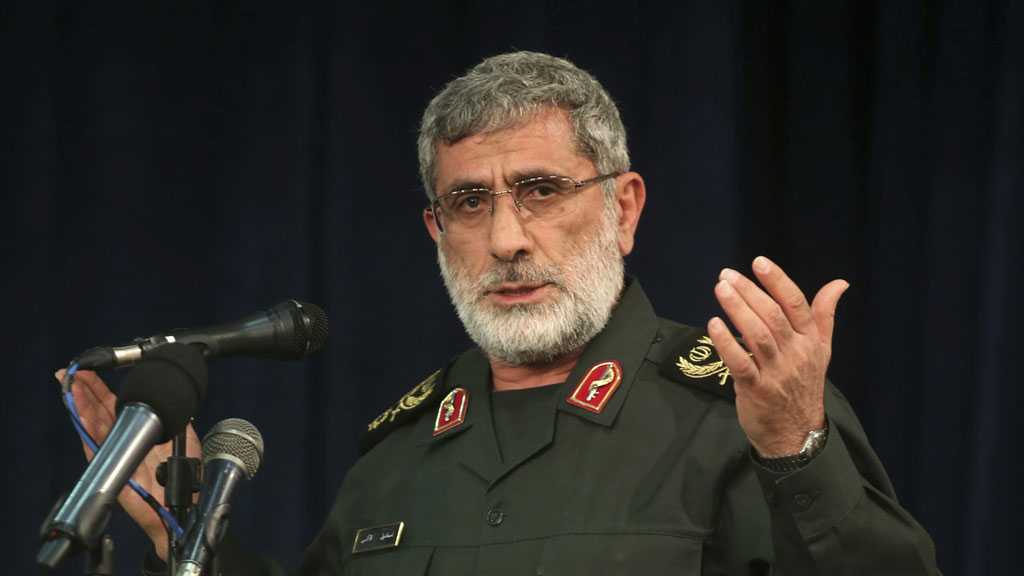
The commander of the Islamic Revolution Guards [IRG] Quds Force, Brigadier General Esmail Qaani, says the United States has been expelled from Iraq and suffered a major defeat in its confrontation with the Islamic Republic of Iran despite its superior military resources and capabilities.
Qaani made the remarks Thursday night during the “Nasr Qarib” ceremony in Tehran, held to commemorate the second anniversary of the martyrdom of Lebanese Resistance leaders Sayyed Hassan Nasrallah and Sayyed Hashem Safieddine.
He said the anniversary was being observed at a time when the United States had withdrawn its forces from Iraq, describing the development as a victory for the Iraqi people and attributing it to the resistance of the Iraqi nation and members of the Resistance Front.
Qaani acknowledged that the region continues to face difficult circumstances but said the Resistance Front is moving forward. He pointed to what he described as growing coordination among its various components, saying their actions are based on planning and calculated decisions.
Addressing Iran’s confrontation with the United States, Qaani said Washington had believed it could force Tehran to surrender within days or, at most, two weeks. According to him, those expectations were contradicted by Iran’s resistance and the failure of what he described as the enemy’s plans.
Referring to the late Leader of the Islamic Revolution His Eminence Imam Sayyed Ali Hosseini Khamenei, Qaani recalled his message during “Nasr” Friday prayers, held one week after Sayyed Nasrallah’s martyrdom. He said the late leader had emphasized that Muslim unity brings honor and, through divine wisdom, helps nations achieve their objectives.
Qaani also called for greater unity and what he described as a stronger “belt of defense” across the Islamic world, extending from Afghanistan to Yemen and from Iran to Gaza and Lebanon. He said the deaths of figures such as Sayyed Nasrallah and Sayyed Safieddine had contributed to greater unity among Islamic nations.
On Iraq, the Quds Force commander said the country had expelled the United States and expressed hope that coordination between the Iraqi government, state institutions and members of the Resistance would contribute to Iraq’s stability, sovereignty and prosperity.
He further argued that remaining elements of the US presence elsewhere in the region should also be removed, saying that he believed signs of such a process were already emerging. Qaani accused Washington of attempting to minimize the significance of its withdrawal from Iraq by focusing public attention on peripheral issues, including aircraft flights.
Discussing the confrontation with Iran, Qaani said the United States and the “Israeli” entity had launched an attack with the objective of forcing the Islamic Republic to surrender. He described the confrontation as part of decades of what he characterized as hostile US actions against Iran.
According to Qaani, the plan was to compel Iran to surrender within a few days. He said, however, that the Iranian people remained firm and that the plans of their adversaries subsequently failed.
Qaani also said that Iran had continued to support its allies and what he described as oppressed nations even during the height of the conflict, adding that Tehran would continue doing so.
Turning to Lebanon, Qaani praised Hezbollah’s performance during what he described as one of the most difficult wars in the organization’s history. He rejected claims that Hezbollah had been destroyed or had lost its ability to fight, saying its fighters entered the battlefield shortly after the war began and continued fighting despite the deaths of senior leaders.
He cited Hezbollah Secretary General His Eminence Sheikh Naim Qassem’s description of the group’s fighting spirit as being inspired by Ashura and Karbala.
Qaani also claimed that the “Israeli” entity suffered more fatalities during the conflict than at any other period in its history, while alleging that the figures were being concealed. These casualty claims were presented as part of his remarks and were not independently established in the report.
Qaani concluded by saying that the Resistance Front would continue along what he described as a path of honor and pride, inspired by its fallen members and the legacy of martyr Sayyed Hassan Nasrallah and martyr Sayyed Hashem Safieddine.
Earlier Thursday, the IRG said the withdrawal of US forces from Iraq represented a step toward what it described as the eventual expulsion of American forces from West Asia and the wider Muslim world.
The US military completed its withdrawal from Iraq on Wednesday, with the remaining troops leaving a base in Erbil under an agreement between Baghdad and Washington to end the US-led military presence.
Iraqi Prime Minister Ali Al-Zaidi, who presided over the handover ceremony, described the withdrawal as the beginning of a “new phase” centered on Iraq’s sovereignty, stronger state institutions and balanced relations with partner countries.
The United States invaded Iraq in March 2003 to overthrow Saddam Hussein’s government, citing allegations that Baghdad possessed weapons of mass destruction. Those weapons were not found.
US-led coalition forces withdrew from Iraq in December 2011 but returned in 2014 following the territorial expansion of the Wahhabi Daesh [Arabic acronym for “ISIS” / “ISIL”], which prompted renewed international military involvement in the country.