Lula Warns Bolsonaro’s Son could Bring Fascism Back to Brazil
By Staff, Agencies
Brazilian President Luiz Inacio Lula da Silva has presented himself as the main obstacle to a return of the far right to power, telling supporters that his candidacy was the only way to prevent his right-wing rival Flavio Bolsonaro and his family from returning to government.
Speaking ahead of a major campaign rally in Rio de Janeiro, the 80-year-old leftist said he had decided to pursue a historic fourth term because he believed his presence in the race was essential to blocking the Bolsonaro family’s return.
“If it weren’t for me standing up to these fascists, they’d easily win another election. I’m the one standing in their way,” Lula told the Flow podcast, before adding, “It’s either me, or it’s barbarism.”
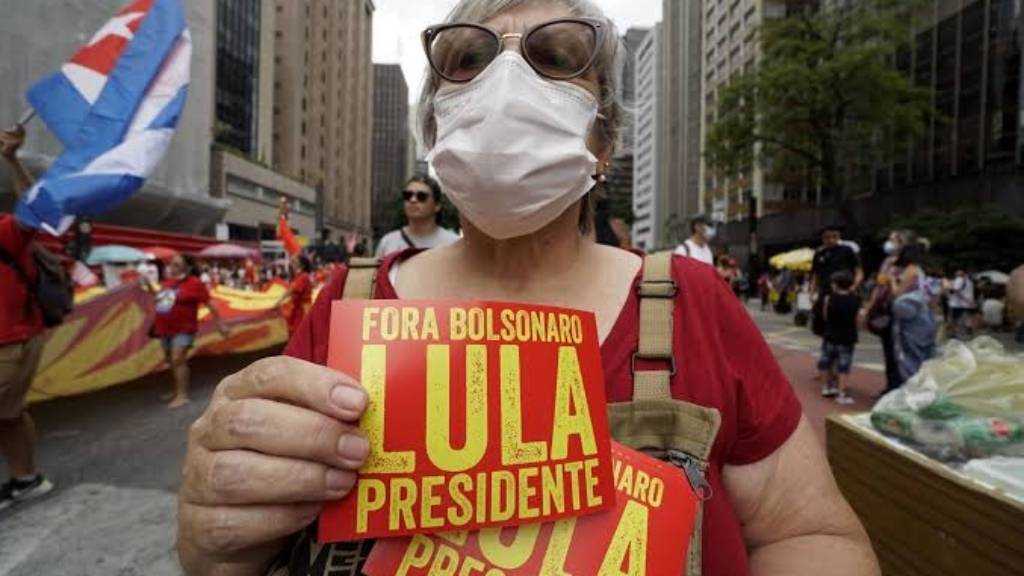
Lula later traveled to Rio for what his campaign described as a “victory march", taking supporters between two sites closely associated with Brazil’s struggle to restore democracy during the 1964-1985 military dictatorship.
After the procession began outside the Candelaria church, Lula said the election was about more than his own political future.
“What’s at stake is not the victory of one man, it is the victory of an idea, it’s the victory of democracy,” Brazil’s president emphasized.
More than a million people, including Lula, gathered at the church in 1984 to demand direct presidential elections. Lula, then a rising politician in his 30s, was among those who addressed the historic demonstration.
“Either we consolidate democracy, or we will lose it,” he said.
Thousands of supporters dressed in red then marched about a mile south toward Cinelandia, where another major pro-democracy demonstration, the March of the Hundred Thousand, took place in 1968.
The rally came two days before voters were due to cast their ballots on October 4, 2026, as Lula sought to mobilize supporters for the final stretch of the campaign.
“No gringo is going to lay a finger on Brazil’s things,” Lula said, indirectly referring to claims that Donald Trump’s administration was attempting to influence the election in Bolsonaro’s favor through economic and diplomatic pressure.
The decision to stage the march between two locations so closely tied to Brazil’s democratic history reflected renewed concerns surrounding the direction of Latin America’s largest democracy as voters prepared to choose their next president.
Polling conducted ahead of Sunday’s vote showed a closely contested race between Lula and Flavio Bolsonaro. The senator is the son of former President Jair Bolsonaro, who is serving a 27-year sentence for plotting a failed coup after losing the 2022 election to Lula.
Many Brazilian democrats have expressed concern that a Flavio Bolsonaro victory could be followed by efforts to release his father and other coup plotters from prison, as well as attempts to weaken or bring democratic institutions, including the Supreme Court, under political control.
“This is the most important election of our lives – and we have to do everything we can to win,” said Marcelo Freixo, a politician from Lula’s Workers’ Party [PT] who is running for a seat in Congress.
Freixo said Brazil had endured 21 years of military dictatorship before fighting to establish its democratic institutions.
“We spent 21 years living under a really harsh dictatorship. We fought so hard to attain our democratic institutions. And a victory for the Bolsonaro family – a family that always … openly defended the dictatorship and tried to stage a coup … would spell the end for our democratic process and institutions.”
Recent polling indicated that the presidential contest remained tightly fought. A Datafolha survey published on October 2 put Lula at 45% of valid first-round votes and Flavio Bolsonaro at 40%. The poll also showed the two candidates statistically tied in a simulated runoff, with Lula at 48% and Bolsonaro at 45%.
The survey was conducted from September 29 to October 1 among 2,506 voters in 152 municipalities and had a margin of error of two percentage points.
A second round is scheduled for October 25 if no candidate receives more than half of the vote. Lula nonetheless told supporters at Friday’s rally that he could defy expectations and secure more than 50% in the first round.
In an online broadcast, Bolsonaro maintained that his campaign would succeed.