USS George Washington Now Sole US Aircraft Carrier Remaining in West Asia
By Staff, Agencies
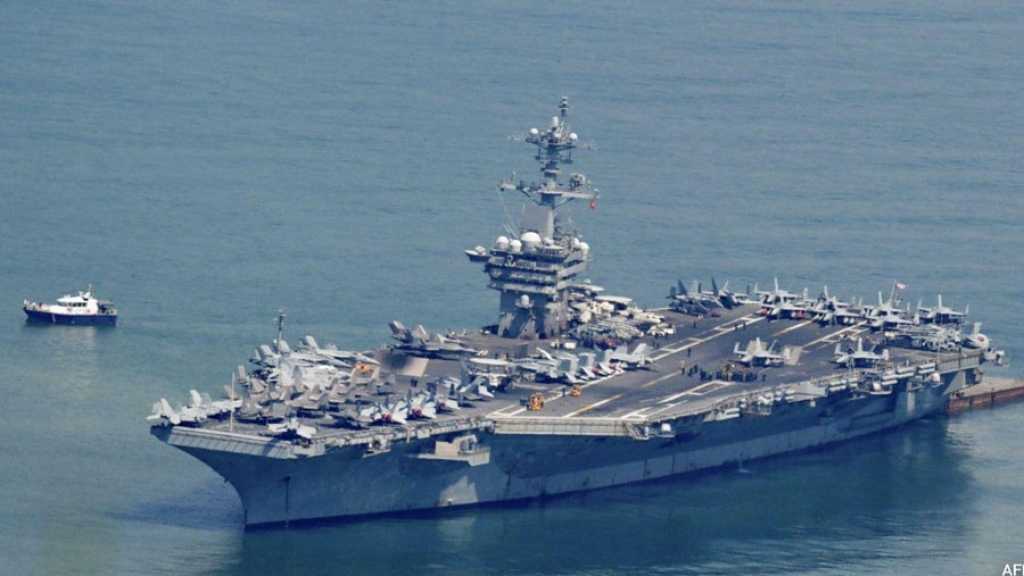
The USS George Washington is now the only US aircraft carrier remaining in West Asia, according to Fox News, as Washington continues to adjust its naval deployment following months of military operations against Iran.
The carrier is currently operating in the Arabian Sea, where it arrived in August to relieve the USS Abraham Lincoln, according to US Central Command [CENTCOM].
The USS George H.W. Bush and the destroyer USS Delbert D. Black have now departed the region and reached Thailand, while the Lincoln is expected to return to its home port in San Diego this week.
CENTCOM has provided an updated picture of the US naval presence in West Asia, showing 17 American warships currently deployed across the region. That figure is slightly below the number of vessels stationed there before the war on Iran began eight months ago.
Most of the US naval forces are concentrated in the Arabian Sea following Iranian missile attacks against American warships in early September. Three guided-missile destroyers remain positioned in the Red Sea.
The Bush and the Delbert D. Black arrived in Phuket, Thailand, on Sunday, October 4, in what the Navy’s 7th Fleet described as a scheduled port visit. The carrier is expected to remain there until October 9.
The George H.W. Bush departed Norfolk, Virginia, on March 31 before sailing around Africa and reaching the Arabian Sea toward the end of April, according to USNI News. The route around the Cape of Good Hope is roughly 40 percent longer than the traditional passage through the Suez Canal and Red Sea, but the alternative route reduces the exposure of US warships to attacks by the Yemeni Armed Forces.
The Bush’s departure from the Arabian Sea was not publicly announced by CENTCOM or the US 5th Fleet, Stars and Stripes reported. Its arrival in Thailand marked the carrier’s first port visit since its deployment and the second time in two months that an American aircraft carrier has stopped in Thailand while leaving the region.
The USS Abraham Lincoln made a similar visit between September 2 and 6, marking its first port call after 265 days at sea.
The Lincoln had deployed from San Diego in November 2025 and participated in the war on Iran as well as the blockade of Iranian ports before being relieved by the George Washington in August.
The unusually long deployment generated criticism from Democratic lawmakers and sailors’ families, who raised concerns about the difficult conditions experienced by personnel aboard the carrier.
The US Navy has subsequently confirmed that eight members of the Lincoln strike group attempted suicide during the deployment, adding another troubling dimension to one of the longest carrier missions of the recent period.
The USS Gerald R. Ford and the Lincoln were among the aircraft carriers deployed for the opening attacks against Iran. The current year has seen some of the longest overseas carrier deployments in recent US Navy history, with the Lincoln, Bush and George Washington all participating in operations connected to the war and blockade.
Washington is already preparing another carrier movement. The USS Theodore Roosevelt departed San Diego on September 27 and is expected to either reinforce or eventually relieve the George Washington. However, it is not expected to reach the region within the next several days, and it remains uncertain how long the George Washington will remain in West Asia once the Roosevelt arrives.
The Makin Island amphibious group, carrying the 13th Marine Expeditionary Unit, also departed San Diego last week and is expected to reach the region by the end of November, Fox News reported.
The George Washington normally operates from Japan, making its deployment to West Asia strategically significant beyond the immediate regional conflict. Analysts have warned that moving the carrier away from the Pacific reduces the number of US carriers available in the region at a time when Washington is seeking to maintain deterrence against China.
The shifting deployments underscore the growing demands placed on the US Navy, with Washington having to balance its military presence in West Asia against its broader strategic priorities in the Indo-Pacific.