Global Stock Markets Mixed as Nvidia and Anthropic Sell-Off Weighs on Technology Shares
By Staff, Agencies
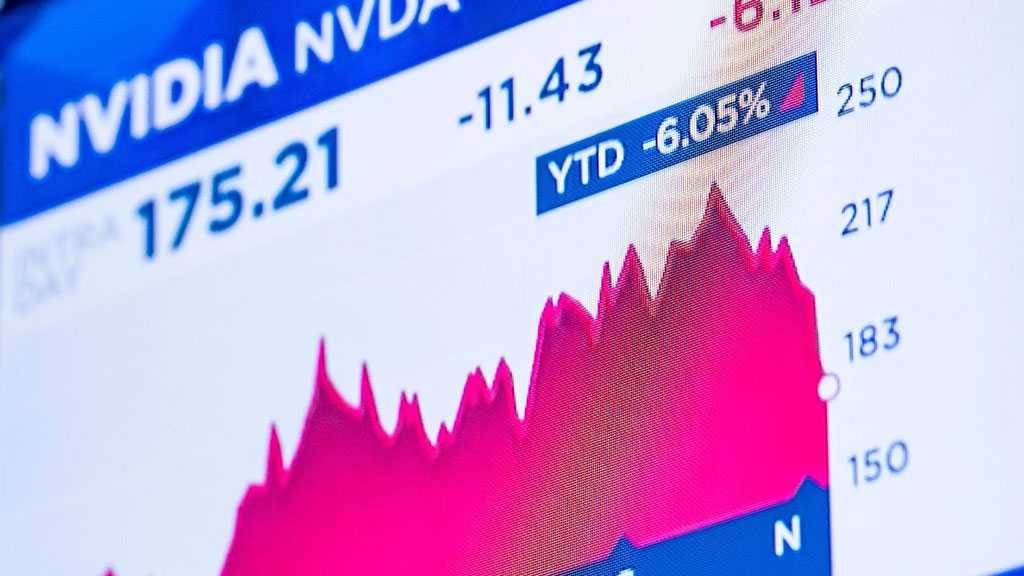
US stock markets ended Tuesday with mixed results as losses in major artificial intelligence and semiconductor companies, particularly Nvidia and Anthropic, dragged the Nasdaq lower following Monday’s strong rally.
The Nasdaq Composite dropped 1.48% to close at 23,733.54, while the S&P 500 declined 0.50% to 7,201.09. In contrast, the Dow Jones Industrial Average advanced 423.39 points, or 0.85%, to 50,018.70, supported by gains in Amgen, Nike and Salesforce.
The decline followed a powerful rally on Monday, when the Nasdaq surged 6.5% and the S&P 500 climbed 4.7%, marking their strongest single-day gains since April 2025. The rebound also ended a seven-session losing streak for the S&P 500, which had fallen more than 10% from its record high by Friday’s close.
Nvidia shares fell nearly 6% in late trading, reversing part of Monday’s 31.5% surge. The company’s board unanimously reinstated co-founder Jensen Huang as chief executive, 11 days after his resignation. The board said it had received input from senior US officials, while an independent committee would continue investigating reports that Huang had been targeted by a foreign intelligence operation.
Anthropic shares also came under pressure, falling more than 6% in late trading and dropping below their initial public offering price of $83. The maker of the Claude artificial intelligence platform had reached as high as $115 following its Nasdaq debut on Thursday.
The company’s public offering generated $93.5 billion in gross proceeds, including $91.6 billion for Anthropic. It also secured an additional $26 billion through a private placement involving seven investors, including Nvidia, Microsoft and Google.
The sell-off spread across the semiconductor sector. Micron Technology shares plunged approximately 11%, Advanced Micro Devices dropped nearly 9%, and Broadcom declined around 4%. All three companies participated in Anthropic’s private placement. Oracle lost more than 3%, while Alphabet slipped approximately 1%.
Meanwhile, the Cboe Volatility Index, a key measure of market uncertainty, rose to 27.34 from Monday’s closing level of 26.62. The yield on 10-year US Treasury bonds stood at 4.932%.
Investors also assessed fresh economic data showing that US consumer confidence increased by 11.4 points to 103.3 in November, according to the Conference Board.
Market sentiment was additionally influenced by a Wall Street Journal report indicating that the US administration was preparing to increase tariffs on China and dozens of other countries.
European stock markets ended lower on Tuesday as technology and semiconductor shares retreated following recent gains, with Italy’s benchmark recording the steepest losses among major regional indexes.
The Stoxx Europe 600 declined 0.66% to 632.74. Italy’s FTSE MIB dropped 1.84% to 48,121.19, while Germany’s DAX lost 1.31% to 25,005.51. Spain’s IBEX 35 fell 0.86% to 19,015.80.
Elsewhere, Britain’s FTSE 100 slipped 0.13% to 10,467.07, while France’s CAC 40 edged down 0.05% to 8,040.49.
Semiconductor stocks were among the biggest losers. STMicroelectronics plunged more than 10% in Milan, while ASML, ASM International and Infineon also recorded declines.
In contrast, French pharmaceutical company Sanofi gained approximately 6% after agreeing to acquire US drugmaker Insmed in a $41 billion all-cash transaction, equivalent to $175 per share.
On the economic front, Germany’s Ifo business climate index improved to 90.6 in November, compared with 90.1 in October.
The European Central Bank set its reference exchange rate for the euro at $1.0963.
Investors are now turning their attention to Wednesday’s US Personal Consumption Expenditures [PCE] inflation report, a closely watched indicator that could provide further insight into inflation trends and the future direction of US monetary policy.
Comments