“KAN” Poll: Eisenkot Leads Netanyahu for the First Time
By Staff, Agencies
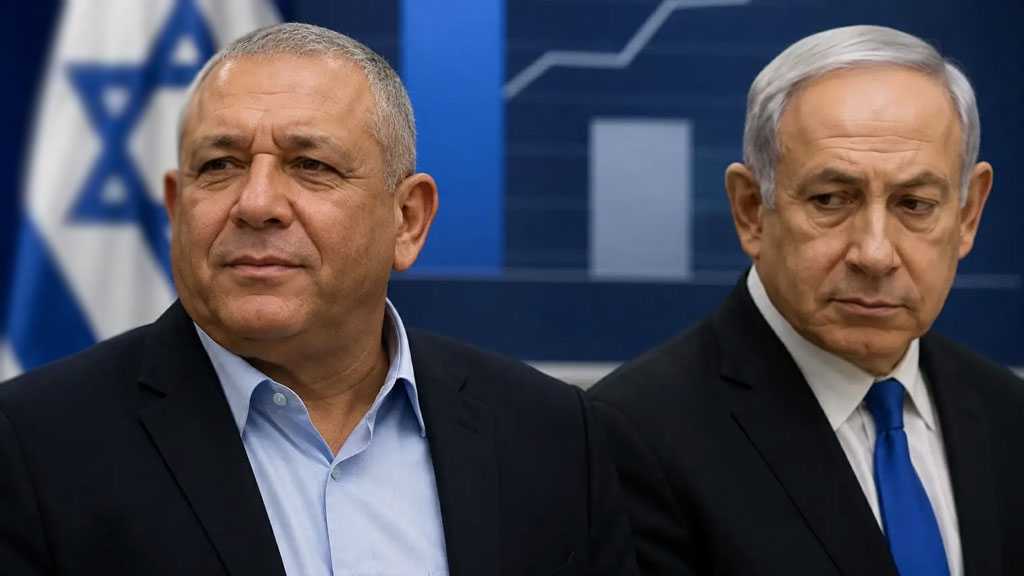
A new poll published by the “Israeli” entity’s public broadcaster “KAN” shows former “Israeli” Army Chief of Staff Gadi Eisenkot pulling ahead of Prime Minister Benjamin Netanyahu for the first time, with his newly formed “Yashar” party emerging as the largest party ahead of the 2026 elections.
According to the survey, “Yashar” would win 24 seats, narrowly beating Netanyahu’s Likud, which would secure 23 seats. The gain appears to come largely at the expense of Naftali Bennett’s “Beyachad” party, which slips by one seat to 15.
The poll also shows Itamar Ben Gvir’s “Otzma Yehudit” dropping to 8 seats, while the “Hadash–Ta’al” alliance loses one seat and falls to 5. Meanwhile, the United Arab List [“Ra’am”] gains a seat, bringing it to 5, and “Yisrael Beiteinu” climbs to 10 seats.
Several parties remain unchanged: The Democrats hold 9 seats, Religious Zionism stays at 5, while both Shas and United Torah Judaism remain on 8 seats each.
Parties failing to clear the electoral threshold include a joint list led by Benny Gantz and Dadi Simchi with 2.7%, an alliance between Hili Tropper and the reservists’ party led by Yoaz Hendel with 3.1%, and Balad, which stands at 2%.
Netanyahu’s bloc is projected to win 52 seats, while parties opposed to him would collectively reach 68 seats. However, since the main opposition parties have ruled out working with “Hadash–Ta’al” and “Ra’am”, their practical total falls to 58 seats.
The poll also tested a scenario involving two new right-wing parties. One, led by Gilad Erdan, Ayelet Shaked and Yuli Edelstein, would win 5 seats, while another headed by Ofer Winter would fail to pass the electoral threshold.
In that scenario, the Erdan-Shaked-Edelstein party draws support mainly from “Likud”, “Yashar”, Religious Zionism, “Otzma Yehudit” and “Yisrael Beiteinu”. Netanyahu’s bloc would then fall to 49 seats, while the anti-Netanyahu camp, together with the new party, would reach 61 seats—enough to form a government without relying on Arab parties.
Another scenario looked at Hili Tropper joining “Yashar” instead of forming his own alliance. That would lift “Yashar” to 25 seats, extending its lead over Likud to two seats, while Bennett’s party would drop to 14.
When asked who is better suited to serve as prime minister, Netanyahu edges Naftali Bennett by 38% to 34%, while 28% say neither is suitable.
In a head-to-head matchup between Netanyahu and Eisenkot, however, Eisenkot leads 41% to 37%. He also outperforms Bennett, 39% to 21%.
Respondents identified security as the issue most likely to shape the next election [25%], followed closely by the October 7 operation and the demand for a state commission of inquiry [24%]. The economy and cost of living came next at 22%, while judicial reform ranked fourth with 12%.
On “Shin Bet” chief David Zini, 40% said he is doing a good job, while 34% disagreed, with opinions sharply divided between coalition and opposition voters.
As for so-called “National Security” Minister Itamar Ben Gvir, 59% rated his performance negatively, compared with 33% who gave him a positive assessment.
The poll also found that 56% of respondents support allowing businesses to open on Saturdays, while 29% oppose the idea.
The survey was conducted on July 12, 2026, by the "Kantar" Institute. It included 551 respondents out of 2,359 people invited to participate, including members of the 1948 community, through an online questionnaire. The margin of error is ±4.2%.
Comments