When Schools Become Shelters: Reviving Education in S Lebanon Amid the Ruins
By Staff, Agencies
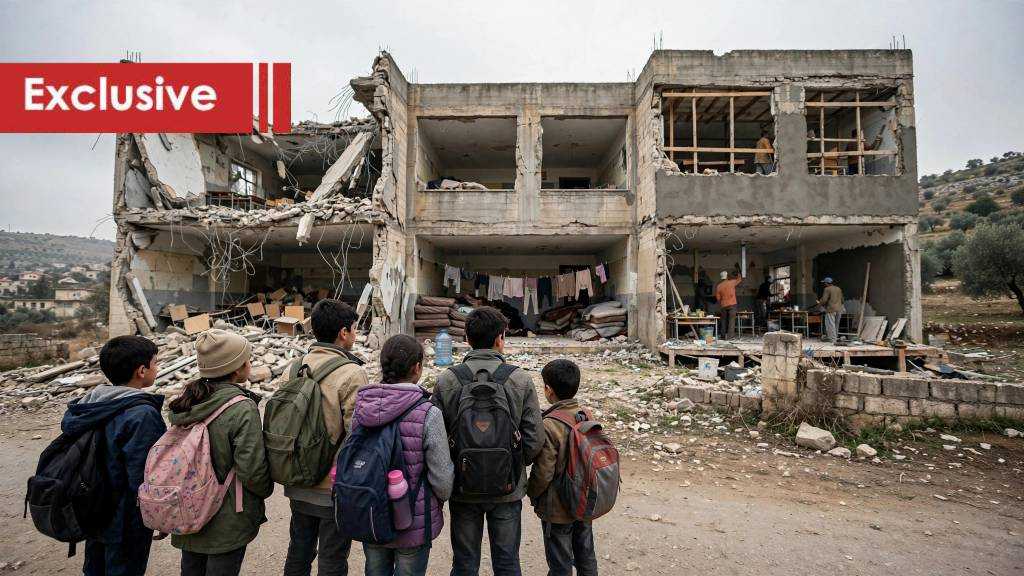
As the new academic year approaches, the condition of public schools in war-affected areas of southern Lebanon has emerged as a key issue, amid extensive damage to educational institutions and the use of some schools as shelters for displaced families.
Against this backdrop, Al-Ahed News reviewed a dedicated assessment of public schools prepared to determine the extent of damage, establish priorities and identify possible solutions, particularly in occupied areas and at schools that are no longer able to receive students under normal conditions. The file is being followed by educational and municipal bodies and committees in coordination with the relevant official authorities.
An official involved in the process told Al-Ahed News that the work was carried out through several committees, including a committee within the Educational Mobilization in coordination with municipal authorities in areas south of the Litani River, as well as a joint committee with the Educational Office of the Amal Movement and the municipal office.
The file was also referred to a central committee comprising the Educational Mobilization and the Educational Office, with the participation of MPs from the Development and Liberation Bloc and the Loyalty to the Resistance Bloc, particularly Dr. Ihab Hamadeh and Dr. Ashraf Baydoun.
The matter was subsequently followed up with the Ministry of Education and its relevant directorates, with several measures and facilitation efforts already initiated.
What Did the Initial Assessment Reveal About Public Schools After the War?
The source said the assessment focused on public educational institutions because they require direct follow-up by government authorities as state institutions, while private schools have greater flexibility in addressing their own challenges according to available resources.
Initial data showed that 25 public educational institutions are located in the occupied areas, most of them having been completely destroyed. Outside those areas, the damage was classified at several levels: 3 public educational institutions were completely destroyed, 15 sustained moderate damage, 48 sustained minor damage and 4 sustained major damage.
According to the file, the completely destroyed institutions include Qabrikha Intermediate School, Majdal Selem Secondary School and Burj Qalaouiyeh Intermediate School.
How Were Partially Damaged Schools Dealt With?
The source said damage at a number of schools would not prevent the academic year from starting, particularly where damage was minor, such as to windows and aluminum fixtures.
At the same time, a file was prepared in cooperation with the Council for the South, classifying schools according to the extent of damage and the priority of intervention.
The source added that the Council for the South had assessed a number of institutions and that rehabilitation work had already begun at some of them, while other schools were rehabilitated by different entities.
What About Schools in the Occupied Areas, Particularly Those That Sustained Major Damage?
Schools in the occupied areas represent the greatest challenge, the source said, particularly those where damage has made it impossible to resume in-person education.
Engineering assessments were therefore conducted at a number of schools to determine whether they remained fit for use. In some cases, buildings were not completely destroyed but were no longer suitable for receiving students because of their structural condition or the extent of the damage.
The priority in such cases is to secure temporary alternative buildings that would allow in-person education to continue wherever possible.
Among the schools whose situations were raised were Al-Samaaiya, Bazourieh Intermediate School and Al-Jmayjmeh Safad. The extent of damage at these schools poses challenges to the resumption of in-person education, while work continues to determine the appropriate solution for each institution.
What Options Are Available to Schools That Cannot Return to Their Original Buildings?
According to the source, the approach is based on a fundamental principle: preserving each school as a functioning educational institution, including its principal, administration and organizational structure, even when in-person education is temporarily impossible.
The available options range from in-person education in an alternative building to blended and remote learning, depending on the circumstances of each school and the geographical distribution of its students and teachers.
Where students and teachers cannot be brought together at a single location, remote learning can be adopted while the school remains operational as an institution until conditions improve.
For completely destroyed institutions, the source said some are making use of whatever classrooms remain usable while simultaneously seeking alternative classrooms and the equipment needed to resume in-person education.
How Many Schools Have Opted for Remote Learning, and How Many Are Seeking Alternative Buildings?
Data from schools in the occupied areas show that 13 have opted for remote learning because of the geographical dispersal of students and teachers and the difficulty of bringing them together in one location.
Another 12 schools have opted to seek temporary alternative buildings to provide in-person or blended education.
The source stressed that this distribution does not mean remote learning is the preferred option in every case. Rather, the circumstances of each area and the geographical distribution of students and teachers determine whether in-person education is feasible or remote learning is necessary.
Has the Process of Securing Alternative Buildings Already Begun?
Efforts to secure alternative buildings have already begun in a number of cases, the source said, citing several examples.
These include Aita Al-Shaab Intermediate School in Bedias; Aita Secondary School and Aitaroun Secondary School in Abbasieh; Naqoura Secondary School and Mansouri Secondary School in the First Intermediate School building; Majdal Zoun Secondary School in Burj Al-Shamali; and the schools of Al-Dhayra, Yarine and Marwahin in Amjad Tyr School.
Some schools face additional difficulties in finding buildings capable of accommodating their students and teachers because of geographical dispersion, particularly in the eastern sector.
By contrast, schools in the western sector can in some cases bring students together more easily in the vicinity of Tyr.
Examples include Al-Khiyam Intermediate School, which could use a building in Blat, while Aitaroun Secondary School may be able to use an alternative location near Sarafand that would better suit the geographical distribution of its students.
In Addition to the Damage, Some Schools Are Being Used as Shelters. How Many Schools Are Affected?
The source said 12 schools are currently being used as shelters for displaced people, accommodating around 580 families, the vast majority of whom are concentrated in Tyr.
Available data show that schools in Tyr are hosting around 450 families, while slightly more than 100 families are distributed among 4 schools outside Tyr.
The situation presents a dual challenge: the continued use of schools as shelters prevents them from being used to receive students at the start of the academic year.
How Is the Use of Schools as Shelters Being Addressed?
The source said a crisis committee had been established in cooperation with the Union of Municipalities of Tyr and the relevant unions and municipalities to identify alternative buildings to which families can be relocated, allowing schools to be vacated for educational purposes.
Several proposed buildings have been identified and the necessary funding secured, while preparations have begun at some locations.
Among the proposed facilities are the vegetable market building in Abbasieh, which has 65 rooms; an unused public school building in Bustan; and an unused private school in Sarafand.
Some of these buildings are already ready, while work on others is expected to be completed by the end of the month, the source said.
Will the Alternative Buildings Be Sufficient to Accommodate All the Families Currently Staying in Schools?
According to available data, the buildings currently being prepared can accommodate between 250 and 300 families.
However, the number of families requiring relocation exceeds that capacity, leaving more than 200 families in need of additional solutions.
This has prompted consideration of using a single building for more than one purpose, with one section allocated to education and another to shelter, provided the two spaces remain separate and the area designated for education is not used as a shelter.
What Are the Main Challenges Ahead of the Start of the Academic Year?
The main challenge involves two parallel priorities: providing shelter for displaced families and securing suitable facilities for the continuation of education, the source said.
The solution requires independent shelter centers separate from schools, or multipurpose buildings that can be divided in a way that prevents disruption to the educational process.
In addition, a number of alternative buildings still lack essential equipment. Securing a building alone does not necessarily mean teaching can begin there.
A file is therefore being prepared to identify essential equipment whose absence could prevent the start of education, with efforts underway to secure it through the Ministry of Education, donors and other entities able to provide assistance.
Does the Security Situation Allow Schools to Reopen on a Stable Basis?
The security situation remains a changing factor that can quickly alter conditions, the source said.
According to available information, the situation in the area south of the Litani River, extending from Naqoura to Al-Khiam, has so far remained relatively acceptable and stable.
Meanwhile, the Nabatieh area has witnessed increased displacement over the course of two days, making the situation of schools there more uncertain.
The source cited Kfar Fila School as an example. The school had been expected to reopen, but its reopening has become dependent on developments on the ground.
Is There Still a Commitment to In-Person Education Despite These Circumstances?
According to the source, some towns remain committed to in-person education wherever possible, not only for educational reasons but also because maintaining the presence and continuity of schools carries significant moral and institutional importance for local communities.
The source stressed that the inability to provide in-person education at a particular school does not necessarily mean that the school itself will cease operating.
Maintaining the school as an educational and administrative entity remains a priority, whether through remote learning or a temporary move to an alternative building, until conditions allow students to return.
How Closely Do These Figures Correspond With Ministry of Education Data?
The official told Al-Ahed News that the field data correspond with Ministry of Education figures by approximately 95%, with the remaining discrepancies mainly attributable to changes in the status of certain schools during the monitoring period.
For example, a school may have secured an alternative building without the information yet being reflected in the central database, or the circumstances of an institution may have changed since the initial assessment.
Do These Figures Cover All Affected Areas in Southern Lebanon?
The source stressed that the figures in the file are linked to the geographical scope covered by the assessment and do not represent all the challenges facing southern Lebanon.
Other files and challenges exist in the southern suburbs and Nabatieh. Expanding the assessment to areas such as Zawtar and Kfar Tibnit could also increase the number of schools classified as being in occupied or affected areas.
However, the main challenges remain broadly similar: securing buildings, ensuring continuity of education, addressing damage and finding solutions to the shelter crisis.
When Is the Situation Expected to Become Clearer Regarding the Start of the Academic Year?
The source said some measures have already been completed, while others remain under implementation and follow-up.
The expectation is that ongoing work will address or significantly reduce most obstacles by the end of September.
Ultimately, the successful start of the academic year will depend on the ability of the relevant authorities to address school buildings and shelter centers in parallel, secure the equipment needed for alternative educational facilities and ensure that war-related damage does not become a long-term obstacle to the continuation of education.