Investigation Exposes Human Cost of Trump’s Third-Country Deportations
By Staff, Agencies
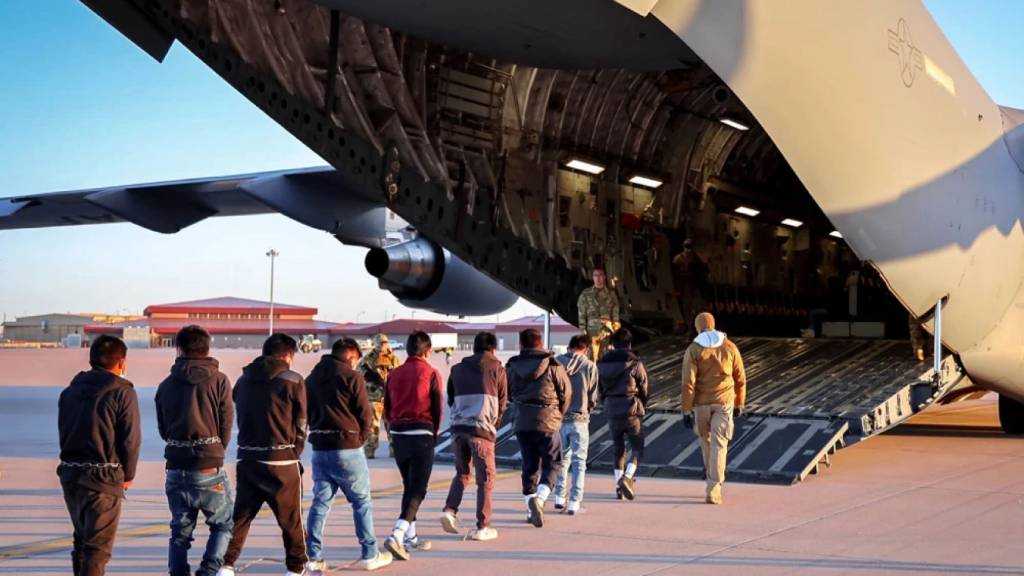
A joint investigation by The Guardian and 23 media organizations, coordinated by Forbidden Stories, has exposed the scale and human consequences of the Trump administration’s third-country deportation program, which transfers migrants and asylum seekers to countries with which they have no ties.
The investigation tracked more than 100 deportation flights to 28 countries, though the actual number is likely higher.
More than 25,000 people have reportedly been deported to countries other than their own, including over 5,000 flown to nations across Africa, Latin America, the Caribbean and Central Asia. Thousands more have been transported by bus to Mexico.
In one case, 18 detainees aboard a US flight discovered only through seat screens that they were being taken to the Central African Republic [CAR], a country many had never heard of.
Some deportees were later sent to countries where US immigration judges had previously found they faced threats to their lives or freedom.
The program has expanded rapidly, with Human Rights First counting a record 16 deportation flights in August to 13 countries.
People from Peru and Colombia were sent to the Democratic Republic of the Congo, while four Cubans, a Brazilian and a Cameroonian were transferred to Equatorial Guinea after refusing to leave a plane in Liberia.
Meanwhile, a US federal appeals court ruled that third-country removals were unlawful because deportees were not given adequate notice to challenge their transfer. The administration is expected to appeal.
The Trump administration says the program is part of its effort to end “illegal and mass immigration,” while human rights lawyers describe it as a deterrent and a challenge to asylum protections.
Documents reviewed by the investigation also show that most of the 35 countries with US agreements have said they will not accept migrants with violent criminal records, despite the administration’s characterization of deportees as “criminals.”
Those deported include people with deep US ties, including parents and caregivers, as well as migrants previously protected from removal after judges found their fears of returning home credible.
The policy has been closely associated with White House deputy chief of staff Stephen Miller, who has pushed for reduced migration.
Current and former US officials told The Washington Post that Miller advanced the policy through State Department appointments, including Christian Ehrhardt, head of the newly established Office of Remigration.
Internal records show the administration has committed at least $410 million to agreements with 38 countries.
Cameroon was allocated $30 million in support for UN operations in exchange for accepting 1,000 migrants, while the Democratic Republic of the Congo was promised $75 million for accepting 2,000. So far, only 44 and 15 migrants respectively have been sent.
The International Organization for Migration [IOM] has provided food, accommodation and psychological support to deportees in 13 countries.
More than 60% of US grants to the IOM during Trump’s second administration have reportedly gone to programs in countries receiving deportees. In CAR, US funding to the IOM reached $85 million, compared with $14 million during the Biden administration.
An internal IOM assessment warned that its involvement could make the agency “perceived as complicit,” while the organization said its assistance is guided by whether it improves migrants’ lives.
Human rights advocates and immigration lawyers remain critical, saying legal avenues for challenging the deportations have increasingly narrowed.