The Yemen Sayyed Nasrallah Saw: From Resisting to Reshaping the Region
Edited by Staff, Al-Mayadeen News
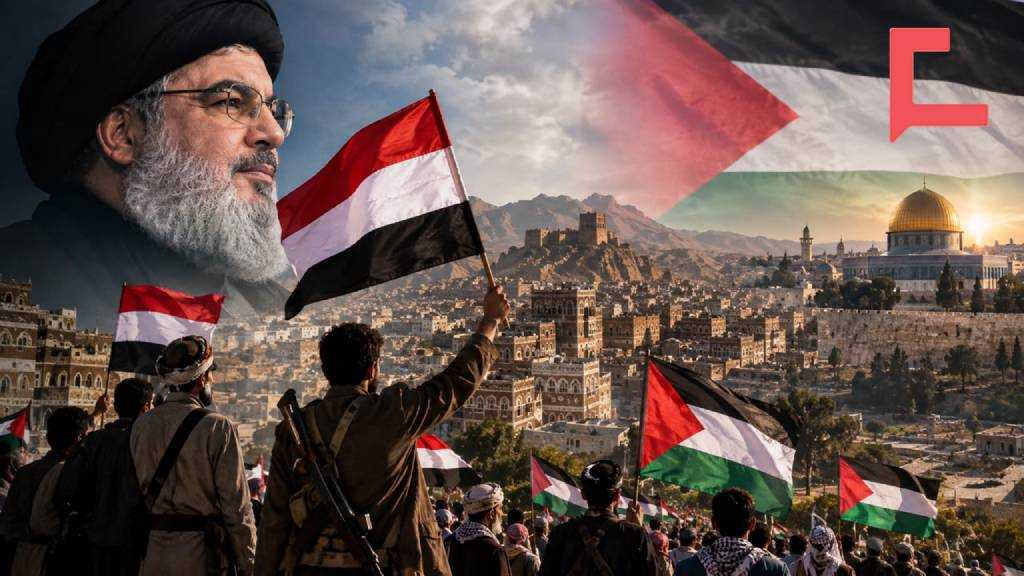
The world saw bombs falling on Yemen. Martyred Lebanese Resistance leader Sayyed Hassan Nasrallah saw what lay behind them.
When a US-backed, Saudi-led coalition launched aggression against Yemen in March 2015, it was presented under the guise of an “effort to restore a political order in Sanaa.” But Sayyed Nasrallah rejected that claim from the outset.
Beneath the language of “restoring legitimacy and security,” he saw an attempt to impose a political outcome on an entire people through overwhelming military force, to break Yemen’s will, restore outside influence, and compel its people to surrender their sovereignty.
Sayyed Nasrallah's assessment was not confined to a single speech.
Beyond the Aggression
Across years of Saudi aggression, the former secretary general of Hezbollah returned to the same themes: Yemen’s Resistance, its sovereignty, the limits of military coercion, and the ability of the Yemeni people to withstand pressure that had been expected to produce political submission.
More than a decade later, Yemen occupies a markedly different place in the regional landscape.
The Saudi-led aggression that began with an attempt to reshape Yemen’s political balance became a prolonged war. The Yemeni Resistance survived years of military pressure and locally developed increasingly sophisticated military capabilities. The war eventually became intertwined with wider regional calculations involving Saudi Arabia, the United States, “Israel”, and the Red Sea.
After October 2023, Yemen’s role expanded again. Sanaa's Yemeni Armed Forces [YAF] began launching operations in solidarity with Gaza amid the "Israeli" genocide, drawing the country directly into the regional struggle for Palestine.
The question, looking back, is not whether Sayyed Nasrallah foresaw every development that followed.
It is more precise, and historically more useful, to ask what he actually identified about Yemen at different moments, what happened afterward, and why prominent Yemenis today believe his reading of their country was significant.
The First Days
Sayyed Nasrallah’s first major solidarity came as the Saudi-led aggression on Yemen was still in its opening hours.
On March 27, 2015, two days after the launch of the aggression, he challenged the argument that developments in Yemen constituted an "existential security threat to Saudi Arabia."
He asked why Saudi Arabia viewed Yemen as a threat while “Israel", with one of the region’s most powerful militaries, remained a far more obvious strategic challenge.
The question reflected one of the foundations of his interpretation of the war: that Yemen was being viewed through the interests of outside powers rather than through the political aspirations of the Yemenis themselves.
Sayyed Nasrallah also challenged claims that Yemen’s emerging political order was simply an Iranian project, asking where the Iranian armies and military bases in Yemen were.
His argument was that the war could not be understood simply as an extension of Iranian-Saudi tension at the time.
He went further, arguing that Saudi Arabia had lost the degree of influence it had previously exercised over Yemen and that the war was intended to restore that influence.
"A Balm for Yemenis' Wound"
For Yemenis experiencing the first hours of the war, the significance of Sayyed Nasrallah’s speeches was immediate.
Dr. Ahmed Ahmed Saleh al-Arami, professor of modern history, president of Al-Bayda University, and deputy chairman of the Preparatory Committee for the International Palestine Conference, remembers the atmosphere vividly.
“That speech was like a balm in the early hours of the coalition aggression against Yemen,” al-Arami said. “At the time, we were following the media, regimes, and statements, all of which were mobilizing against the Yemeni people. The only position that came forward with such strength was that of the late Sayyed Hassan Nasrallah.”
Al-Arami said Sayyed Nasrallah did not merely condemn the aggression. He explained its underlying objectives and challenged the assumption that military superiority would translate into political victory.
He recalled Sayyed Nasrallah concluding the speech with a declaration of confidence in Yemen’s ability to withstand the aggression.
“The Yemeni people will rub the noses of the Saud family in the soil of Yemen,” al-Arami recalled him saying during his speech at a crowded ceremony to mark the Tenth of Muharram in Beirut’s Southern Suburb [Dahieh] in October 2016.
“The Saudi war on the Yemeni people does not seem to be fought on the basis of achieving political goals, but reflects the level of grudge and revenge. This form of crime, which grinds humans, stone, children, and adults, and targets everything in Yemen, is Saudi Arabia’s hatred war of a Wahhabi taste,” Sayyed Nasrallah added at the time.
Inevitability of Yemen’s Victory
Dr. Khaled Yahya al-Emad, a member of the Yemeni Shura Council, similarly places Sayyed Nasrallah’s position at the very beginning of the war.
“When we remember or speak of the late Resistance leader Sayyed Hassan Nasrallah, he was someone who saw with the light of God,” al-Emad stressed. “From the very first day of the aggression by the Saud family against Yemen, he said that victory would be on Yemen’s side.”
For al-Emad, Sayyed Nasrallah’s assessment remained consistent throughout the war.
“He consistently spoke about the Yemenis, Yemen, and their suffering at the hands of the Saud family, as well as the inevitability of their victory,” he stressed.
“And that is what happened. The Yemenis emerged victorious, and today they are rubbing the noses of the Saud family in the mud,” he affirmed.
The language was emphatic, but it reflected a broader assessment that Yemen’s Resistance possessed the determination to withstand an aggression built on military superiority.
That understanding would inform Sayyed Nasrallah’s subsequent speeches as the war entered a prolonged phase.
The Limits of Force
As the war continued, Sayyed Nasrallah’s analysis increasingly focused on the widening gap between military power and political outcomes.
In a 2016 Al Mayadeen interview, he described the war on Yemen as unjust. He questioned the logic of continuing an aggression that had already failed to produce the political submission its backers sought.
“Their scheme in Yemen has failed,” he emphasized.
He also challenged the assumption that Saudi Arabia could ultimately use its financial resources to reconstruct Yemen and translate that reconstruction into political control.
The point was central to his broader understanding of Resistance: destruction could be inflicted from the outside, but political submission could not simply be purchased or imposed.
By then, the war was already demonstrating its durability.
Sayyed Nasrallah described the Yemeni people as having endured an extraordinary period of fighting and emphasized the role of their determination and military capabilities in preventing their defeat.
"The Unjust War"
Years later, in December 2020, he returned to the same argument.
“The Yemeni people have fought for more than 2100 days,” Sayyed Nasrallah said, pointing to the Yemeni people’s determination and access to weapons as fundamental sources of their ability to continue fighting.
“Look, my understanding is that Saudi Arabia—particularly in recent years—does not act rationally. Rather, it acts out of spite and hostility. This war on Yemen—tell me, what is the reason for it? What logic? What basis? What law? What interests? What principle? What is the rationale behind this unjust war?” he said at the time.
The significance of the statement lies partly in its timing.
By late 2020, the war had lasted for more than five years. Whatever expectations had accompanied the opening of the Saudi-led aggression, the war had not produced a quick political settlement.
For Sayyed Nasrallah, the persistence of the war highlighted the distance between the scale of military force deployed against Yemen and the political objectives it was supposed to achieve.
When the battlefield became regional
The war’s trajectory increasingly complicated the idea that the war could be contained within Yemen.
In 2019, the YAF operations against Saudi oil facilities demonstrated the ability of the aggression on Yemen to spill over to critical infrastructure beyond Yemen’s borders.
They showed the extent of deterrence Sanaa managed to establish.
For Sayyed Nasrallah, the war on Yemen was never entirely separate from the wider balance of power in West Asia.
He said in a televised speech on September 20, 2019, “The thing that will protect the installations and infrastructure in Saudi Arabia is halting the war against the Yemeni people.”
Noting that the YAF’s operation had initially halved Saudi oil output, he added, “Your house is made of glass, and your economy is made of glass....”
After all, Yemen’s own leadership had made decisions, developed military capabilities, and increasingly affected the strategic significance of its geographic position.
The Voice Yemenis Heard
For the top Yemeni figures interviewed by Al Mayadeen English for this article, Sayyed Nasrallah’s significance cannot be explained entirely through military or geopolitical analysis.
Abdul Rahman Alahnomi, chairman of the General Corporation for Radio and Television, described Sayyed Nasrallah as a prominent voice defending the injustice inflicted upon the Yemenis.
“The late Resistance leader Sayyed Hassan Nasrallah was a beacon of defense against the injustice suffered by the Yemeni people,” Alahnomi said. “His positions of solidarity with Yemen in confronting the Saudi-American aggression were like a balm for our wounds, while also serving as a source of inspiration for other free people around the world and encouraging them to adopt similar positions toward what was happening in Yemen.”
For the Ambassador in the Ministry of Interior in Sanaa, Abdullah Ali Sabri, Sayyed Nasrallah's speeches became something Yemenis actively awaited.
Sabri heartfully recalled Sayyed Nasrallah, describing his speech on the second day of the aggression as the greatest position he had taken in his life.
He also remembered Sayyed Nasrallah asking, “If the Yemenis are not Arabs, then who are the [true] Arabs?”
In a similar vein, Abu Aqil Abdullah Alnimi, a member of the Political Bureau of Ansarullah, stressed that “Sayyed Nasrallah was the icon of his time and the leader of his era; his speeches were a balm and a source of healing."
Profound Loss
The significance of Sayyed Nasrallah’s words came from their perceived sincerity.
Yemenis believed that Sayyed Nasrallah was not speaking about their suffering as an abstract geopolitical issue.
“He spoke to Yemenis with emotion, loved Yemen deeply, and made that clear through his words and speeches,” Alnimi said.
That emotional connection became particularly important during an aggression in which Yemenis often felt isolated internationally.
“There was no one in the world who would wipe away our tears or tend to our wounds except the late Sayyed Hassan Nasrallah,” Alnimi emphasized.
A Relationship Beyond Political Solidarity
Alnimi recalled a relationship that, in the perception of many Yemenis, went beyond political solidarity.
“We considered him as though he were among us, as though he were the leader who taught us, advised us, guided us, and raised our morale,” Alnimi said.
For Alnimi, that made Sayyed Nasrallah’s martyrdom a particularly profound loss.
“Sayyed Nasrallah’s absence was, for us, a great wound that will never heal and can never heal,” Alnimi stressed. “He left behind a great and profound void that no one else can fill.”
Orphaned Yemen
Alnimi described Yemen during the war as an isolated country.
“Yemen was an orphan. It had no one to support it, no one to stand by its side, and no one to wipe away its tears or tend to its wounds except the martyr, the martyr of humanity, and the martyr of all Muslims, Sayyed Hassan Nasrallah,” Alnimi said.
On his part, Sabri likewise described Sayyed Nasrallah’s speeches as a key source of confidence and morale during the confrontation.
Their recollections reveal why Sayyed Nasrallah’s Yemen speeches acquired a significance that cannot be reduced to their geopolitical content.
For these Yemeni figures, he was not merely an outside political leader commenting on a foreign war. He was someone who repeatedly acknowledged Yemen’s suffering, defended its right to resist, and treated its people as actors who should be able to determine their own future.
2017: "I Wish I Were a Fighter in Your Ranks"
Meanwhile, Al-Arami remembers another moment that, in his view, demonstrated the depth of Sayyed Nasrallah’s identification with the Yemeni Resistance.
During the escalation of the Battle of the Western Coast in 2017, al-Arami recalled Sayyed Nasrallah saying on June 30, 2018, “I wish I were a fighter in your ranks, under the banner of your dear and courageous leader, Sayyed Abdul-Malik Badr al-Din al-Houthi.”
The statement came at a time when fighting was intensifying along Yemen’s western coastline.
Al-Arami said the words resonated with fighters and strengthened their morale.
The episode is significant not because one speech can be shown to have determined the course of a battle, but because it demonstrates how Sayyed Nasrallah’s public language about Yemen had evolved.
He was no longer merely explaining the struggle to an external audience.
He was addressing the Yemeni Resistance itself.
Bread Under Siege
Another recollection from al-Arami reveals a different side of Sayyed Nasrallah’s relationship with Yemen.
After Sayyed Abdul-Malik Badr al-Din al-Houthi said on May 23, 2021, that Yemenis were prepared to share their daily bread with Palestinians, Sayyed Nasrallah reportedly responded on May 25, 2021, by asking whether Yemenis themselves had enough food under the Saudi blockade.
“Sayyed, you yourselves are under siege. Do you even have bread to spare to share with the Palestinian people?” Sayyed Nasrallah asked at the time, reflecting the depth of the Yemenis' altruism.
The exchange captured a defining thread running through Sayyed Nasrallah’s speeches on Yemen: the connection between Resistance, human dignity, and the suffering of peoples under siege.
Yemen’s support for Palestine was not occurring in conditions of prosperity or security. It was being articulated by a society enduring war and deprivation itself.
Historical Moment
For al-Arami, Sayyed Nasrallah understood the significance of that gesture and responded to it emotionally.
The moment also foreshadowed a development that would become increasingly important years later: Yemen’s identification of its own struggle with the Palestinian cause.
From War on Yemen to the Red Sea
The next transformation in Yemen’s role occurred after the Saudi-led aggression had already reshaped the country’s military and political landscape.
The emergence of increasingly capable Yemeni missiles and drones altered the strategic equation with Saudi Arabia and later created a wider regional dimension to the struggle.
Then came October 2023.
As “Israel” launched its genocide in Gaza, the YAF declared on October 19, 2023, that their military operations would target "Israeli"-linked interests and shipping in support of the Palestinian cause.
The Red Sea consequently became one of the most important theatres in the broader regional confrontation.
What had begun in 2015 as a Saudi-led aggression centered on Yemen’s political order had acquired consequences for international maritime traffic, regional security, and US occupation forces’ deployments in West Asia.
This marked a profound change in Yemen’s position.
A country long neglected, exploited, and subjected to devastating aggression had emerged as a force capable of shaping strategic calculations far beyond the Arabian Peninsula.
Reshaping the Regional Balance
For years, Sayyed Hassan Nasrallah insisted that Yemen should never be viewed as politically passive or strategically marginal.
Yemeni leaders made their own decisions. Their actions reflected their own political calculations, their interpretation of the Palestinian cause, and their assessment of Yemen’s interests.
Sayyed Nasrallah told Al Mayadeen's Chairman of the Board of Directors, Ghassan Ben Jeddou, that “in the war on Yemen, Hezbollah is not qualified to play the role of mediation, because we are a party that sides with Sayyed Abdul-Malik al-Houthi, the Yemeni people, and Ansarullah movement.”
Sayyed Nasrallah delivered these remarks during the “Dialogue of the 40th Anniversary” on the occasion of the 40th anniversary of Hezbollah’s founding on July 25, 2022, adding that “the mediator usually requests concessions from the two parties, but what concessions can be requested from Ansarullah?”
He stressed that “the Iranians gave a clear answer regarding mediation in the Yemeni war, which means that the Yemenis won’t, in any circumstances, waive their rights.”
Yemen and Palestine
The connection to Palestine was not an afterthought in Sayyed Nasrallah’s understanding of Yemen.
From his earliest speeches, he repeatedly challenged Arab governments over their focus on Yemen while “Israel” remained at the center of the region’s strategic landscape.
“If the aim of the war on Yemen is to save the Yemeni people, then why did Saudi Arabia abandon the Palestinian people for long decades?” the martyred leader said in a speech aired on Al Manar TV in March 2018.
Over time, he increasingly described the different Resistance fronts as interconnected.
That framework became particularly relevant after October 2023.
Yemen’s military operations in support of Gaza transformed the country’s regional role and placed it directly within a confrontation involving “Israel", the United States, and other Western imperialist powers.
An Explicit Connection
For Yemeni figures such as Alahnomi, the connection was explicit.
He linked the Yemeni confrontation with the broader struggle for Palestine and viewed Yemen’s later military posture as part of its commitment to the Palestinian cause.
The significance of this development extends beyond the language of regional alliances.
It demonstrated how Yemen’s geographic position on the Red Sea and near Bab al-Mandeb could give a relatively isolated country considerable strategic leverage.
That was a dimension of Yemen’s importance that became increasingly difficult to ignore.
Looking Back
What, then, can be said with confidence about Sayyed Nasrallah’s reading of Yemen?
The record establishes that he envisioned every subsequent event.
He questioned whether military aggression could produce political submission. He treated Yemen as a political actor rather than merely a theatre for a wider regional confrontation. He emphasized the capacity of its people to endure pressure and repeatedly warned that the consequences of the war could extend beyond Yemen’s borders.
The subsequent course of the war gave those arguments a historical record against which they could be assessed.
The Yemeni Resistance survived the aggression and developed significant military capabilities. The war affected Saudi territory and later international maritime routes in the Red Sea. Yemen emerged as an actor capable of shaping regional calculations, while its Resistance became increasingly connected to the Palestinian cause.
These developments help explain why top Yemeni figures continue to return to Sayyed Nasrallah’s speeches.
Yemen’s Suffering Matters in its Own Right
Alnimi embraced them for championing Yemen with a depth of feeling that was unmistakable.
Al-Emad sees in them an early confidence in Yemen’s ability to endure.
Al-Arami remembers them as moments that provided reassurance when Yemen appeared isolated.
Alahnomi recalls them as a form of solidarity that transcended conventional political statements.
Sabri remembers them as words that made Yemenis feel that someone beyond their borders was listening.
Their testimony also reveals something that a purely strategic reading of Sayyed Nasrallah’s speeches would miss.
His importance to many Yemenis was not only that he assessed the war differently from Saudi Arabia or Western imperialist governments.
It was that he spoke about Yemen as its suffering mattered in its own right.
A Window into Sayyed Nasrallah’s Wider Vision
The Yemen story ultimately points beyond Yemen.
Sayyed Nasrallah’s understanding of the region was built around a recurring set of ideas: Resistance, sovereignty, deterrence, Palestinian centrality, and the limits of external power.
Those ideas appeared in his discussions of Lebanon, Iran, Syria, and Palestine as well.
Lebanon was viewed through the question of Resistance to "Israeli" aggression.
Syria was understood within a wider struggle involving the state, armed groups, and foreign meddling.
Palestine remained, in his speeches, the central cause around which much of the region’s political struggle continued to revolve.
Yemen became another expression of that broader worldview.
An Emerging Power in West Asia
Yemen's trajectory was particularly significant because the country underwent, within a decade, a dramatic transformation in its regional position.
The record shows a regional leader who consistently argued that Yemen’s political agency and capacity for Resistance were being underestimated.
The years that followed provided substantial evidence against which that argument could be assessed.
Perhaps that is the most enduring significance of Sayyed Nasrallah’s Yemen speeches.
They were not simply predictions about how a particular war would end.
They were part of a broader argument about power in West Asia: that military superiority does not automatically translate into political control; that local actors cannot always be reduced to proxies of larger powers; and that societies subjected to external pressure can, under certain conditions, transform Resistance into strategic influence.
What happens when a country refuses to surrender simply because a more powerful coalition demanded so?
For Yemen, the answer unfolded over more than a decade of war.
For Sayyed Nasrallah, it was a conviction he articulated from the very first days.
For the wider region, Yemen stands as a powerful testament to how an aggression launched to subjugate a nation can instead transform the strategic map of West Asia. What began as an attempt to break Yemen’s political will could not extinguish its Resistance or silence its voice.
And through those years, Sayyed Hassan Nasrallah’s unwavering belief in Yemen became part of the country’s own story, a legacy carried in the memory of its people and preserved among those who continue to see Resistance as a force capable of defying domination.
His words endure not simply as memories of a revolutionary leader, but as part of Yemen’s history and the wider history of Resistance.