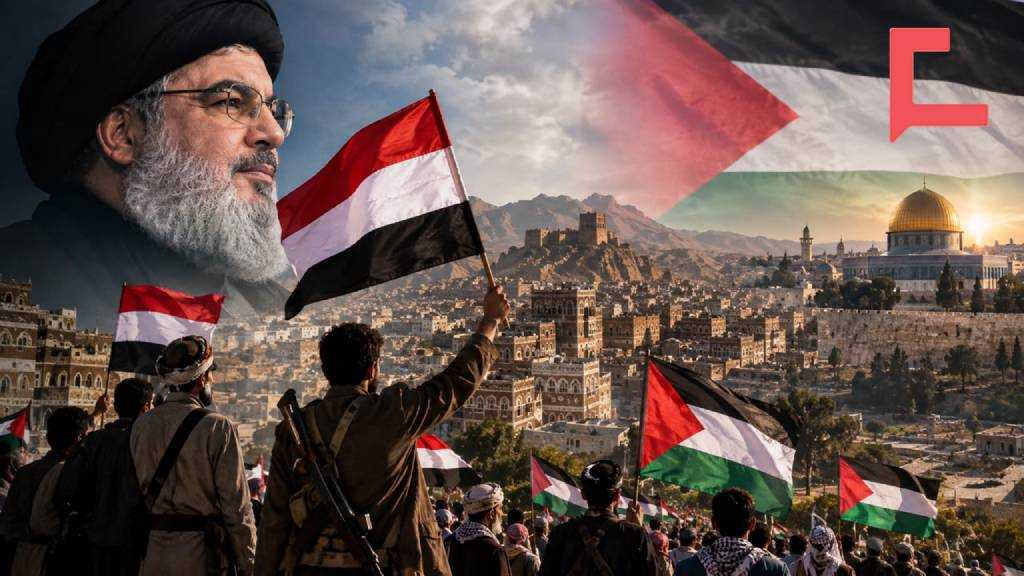
Sayyed Nasrallah: The Miracle of the Global Revolution
Translated By Al-Ahed News
Saif Dana — Al-Akhbar newspaper
“Never in the theater of history has there appeared a single figure endowed with a greater gift than this dark-skinned revolutionary.”
C. L. R. James on Toussaint Louverture [The Black Jacobins]
Two hundred and thirty-five years ago, around this time, specifically on the evening of August 14, 1791, Haiti’s revolutionary leader at the time, Dutty Boukman, gave his final instructions to the leaders of the revolution who had come to meet him at night in “Bwa Kayiman,” carrying torches to light their way on a night that historians describe as exceptionally stormy.
A week later, on August 22, the revolution erupted across the northern plains surrounding the city of Cap-Haitien. That day, the revolutionaries burned more than 1,200 plantations and killed more than 1,000 white settlers. As one account put it, “the entire northern section of the city became a wasteland. The entire horizon was a massive wall of fire, and from that wall enormous quantities of thick black smoke continued to rise, so dense that the people of the city could not distinguish night from day for three consecutive weeks. Meanwhile, burning sugarcane straw fell like snowflakes, covering the city and port and threatening to destroy them completely.”
Twelve years after that night, and after several extremely bloody rounds of fighting in which the revolution’s first leader, Dutty Boukman, was killed in November 1791, followed by his brilliant successor Toussaint Louverture, who died in French captivity on April 7, 1803, the Haitian revolutionaries defeated the armies of the United States, France, Spain and Britain, along with their vast resources and advanced weaponry. Jean-Jacques Dessalines, who led the final phase of the revolution, declared Haiti’s independence on January 1, 1804.
One hundred and twenty-six years later, or roughly 110 years ago, specifically at 9:45 p.m. on November 6, 1917- October 25 according to the Julian calendar- the cruiser Aurora, then anchored on the banks of the Neva River that runs through the Russian city of St. Petersburg, fired a thunderous artillery shell into the air. It was the signal for the Bolshevik forces and their supporters to attack the Winter Palace. Shortly afterward, Red Army detachments stormed the Winter Palace like a hurricane, ushering history into a new phase that would change the world.
Then came a succession of major historical events and extraordinary scenes. Thirty-nine years after that night, and four years and three days after the July 1952 Revolution, specifically at 8:30 p.m. on July 26, 1956, from Mansheya Square in Alexandria, President Gamal Abdel Nasser announced the nationalization of the Suez Canal. The announcement heralded the transformation of the idea of the Arab collective and nation into a powerful historical force opposed to the strategy of Western colonial domination.
Nineteen years later, on April 29, 1975, Vietnamese General Văn Tiến Dũng ordered the People’s Army of Vietnam to begin implementing the “Ho Chi Minh Campaign” and liberate Saigon.
Just two days later, on May 1, the world watched in astonishment as People’s Army tanks stormed the presidential palace, in a stark declaration of the defeat of the most powerful empire in history. Three years and nine months after the liberation of Saigon, on February 1, 1979, millions of Iranians who had risen against the Shah’s regime since January 1978 welcomed Ayatollah Ruhollah Khomeini back from exile in triumph. Two months later, on April 1, the Islamic Republic was established.
On May 25, 2000, exactly 25 years and 25 days after the liberation of Saigon and 21 years and three months after Khomeini’s return, and at the end of a stunning scene of chaotic withdrawal and humiliating defeat, a defeated and broken “Israeli” officer named Benny Gantz closed the Fatima Gate in southern Lebanon, believing, as did his government, that an iron gate could halt the consequences of that bitter defeat—the first of its kind in the history of the Arab-“Israeli” conflict. But its repercussions would grow, and this pivotal event, in its date, timing, meaning and leader, would become an exceptional model among the exceptional examples that preceded it, as we shall see.
What is striking is that none of these historical events, nor many other similar events in Latin America, Africa and Asia, took place in the location from which they were supposed, or expected, to emerge.
As many had understood it, the center of the capitalist world was the presumed, natural, and expected place from which the historical force capable of changing and liberating the world should emerge and take shape. The factories, capital, and technology were concentrated in the countries of the global capitalist center. Modern social classes emerged there, and there too the fundamental historical contradiction between capital and labor became clearer and more mature.
But the history of the past centuries, particularly the 20th century and the portion of the 21st century that has passed, tells a completely different story. What all these great and astonishing scenes have in common, along with the other genuine revolutionary events that captivated the world, is that they did not take place in Europe or the US. They took place on the periphery, at the margins, in the Global South.
What may appear in this narrative as a major paradox is, at its core, an expression of the structure of interests that objectively shifts the initiative for leading historical action toward the places where the contradictions of the global system are most concentrated—namely, the Global South.
Thus, sites of subordination became sites of struggle and Resistance. This is precisely why Anouar Abdel-Malek challenged the view of the Western proletariat as the vehicle of global revolutionary change and linked the possibility of breaking capitalist domination to the formation of a counter-front combining national liberation and social revolutions. Franz Fanon argued similarly in The Wretched of the Earth, as did Amílcar Cabral in his writings on liberation movements and culture.
The May Speech: A Manifesto of the Global South
On May 26, 2000, at the conclusion of his historic victory speech, Sayyed Hassan Nasrallah, the martyred leader, addressed Palestinians, Arabs, and Muslims, summarizing some of the lessons of the Lebanese Islamic Resistance’s experience and presenting the victory as a model from which the Arab and Muslim peoples, particularly the Palestinian people, could draw a path forward:
“We dedicate this victory to our oppressed people in occupied Palestine and to the peoples of our Arab and Islamic nation. From here, from liberated Bint Jbeil, I address the oppressed, suffering, and persecuted people of Palestine. Our people in Palestine: your destiny is in your own hands...
People of Palestine, your path to freedom is the path of Resistance and the intifada—serious resistance and a genuine intifada, not an intifada within the framework of Oslo, nor an intifada serving the negotiator who is making concessions in Stockholm... We present this outstanding Lebanese model to our people in Palestine.”
To a reader or observer, it might appear that the victorious martyred leader was presenting a decisive historical argument against the negotiating options pursued by the Palestinian leadership and some Arab regimes, which, on the eve of liberation itself, had demonstrated that their course had essentially been established and designed to liquidate the Palestinian cause and Arab causes in accordance with broader regional and international arrangements.
Yet the implications of the speech by the martyred leader who had led the Resistance to victory in May under such circumstances went far beyond that.
Nasrallah was also addressing and making the case to all the peoples and revolutionaries of the Global South. The Oslo Accords and the negotiating process chosen by the Palestinian leadership and some Arab states were not simply the product of a local Palestinian context, nor even of the Arab and regional situation. They were also, and perhaps more importantly, connected to the international structure that emerged following the end of the Cold War and the shift in the global balance of power in favor of the US and the Western bloc.
To understand the distinctive nature of the experience represented by the Islamic Resistance in Lebanon under the leadership of the martyred Nasrallah at that time, it is necessary to understand it within the historical context on the eve of the Oslo Accords.
The world at that time was approaching a state of almost complete Arab and global surrender and submission, were it not for the existence of the Islamic Resistance in Lebanon, which represented the sole exception in the Arab region.
In the late 1980s and early 1990s, the world witnessed major transformations that led to a strategic restructuring of the international order with the end of the bipolar system. In June 1989, Poland became the first Eastern European and Warsaw Pact country to fall and undergo a complete transition to the opposing capitalist camp. Hungary followed three months later.
Before the remaining dominoes of the Warsaw Pact fell and the alliance was formally dissolved in July 1991, Berlin and its wall fell, becoming the symbolic event marking the end of the socialist bloc.
On December 26, 1991, the Supreme Soviet held its final session and announced the formal and final dissolution of the Soviet Union, which was divided into 15 states, bringing an entire historical era to an end.
The principal consequence, one that would affect every corner of the world, was the transition of the international system from the relative balance imposed by bipolarity to absolute US dominance.
In the Arab and regional sphere, the transformations were no less profound. Rather, they reflected the international reality. On the morning of January 17, 1991, from Arab territory in the Gulf itself, and with the participation of Arab armies, the US war against Iraq began. It ended with the destruction of one of the most important Arab and regional powers and the reshaping of the regional balance of power.
In the US, the sponsor of the "Israeli" entity, there was perhaps no greater expression of the euphoria of victory than the narrative of the “end of history,” articulated in Francis Fukuyama’s thesis following the collapse of the Soviet Union.
History does not end, of course, as Fukuyama’s nonsense suggested, nor can it end at any particular point. Yet Fukuyama’s claim reflected the prevailing intellectual and political mood of that period: that the Western model had achieved a final, decisive, and absolute victory, and that the major ideological and political alternatives were incapable of presenting a competing global model.
The ideology of the end of history was part of a broader moment in which the political, economic, and intellectual dominance of the West was being entrenched, as part of a comprehensive political—and indeed historical—effort to evacuate knowledge of political content and silence the voices of the peoples of the world, particularly the oppressed peoples of the Global South.
Thus, at the beginning of the 1990s, the international system appeared to be moving toward the entrenchment of a single global model, politically, economically, and culturally, led by the US and its allies.
The global scene suggested a complete worldwide surrender to US hegemony, to the point that even the idea of Resisting and rejecting these arrangements appeared to be madness and suicide, and victory over them would require a miracle.
With the exception of Cuba, China, and North Korea, little remained of the camp opposed to capitalist domination. Vietnam and Laos would gradually adopt neoliberal reform programs.
The only public insistence on continuing to resist domination came from Cuban leader Fidel Castro, who saw submission to capitalism as a surrender of Cuba’s independence and the objectives of its revolution, and from the martyred Sayyed Hassan Nasrallah, who had only recently assumed the secretary-generalship and leadership of the Resistance on February 16, 1992, declaring: “We will continue on this path.”
To understand more deeply the significance of the martyred leader’s words, “We will continue on this path,” which represented the doctrine of the Resistance that achieved victory in May 2000, in July, through the support front, endured at Ali al-Taher, and continues to this day, one must also understand them in their historical context.
The martyred leader did not assume the secretary-generalship of Hezbollah and the leadership of the Resistance at a moment of rising Arab and global revolutionary movements, as had been the case with previous leaders of liberation movements in the Global South since the middle of the 20th century.
The international circumstances at that time, particularly the structure of bipolarity, provided national liberation movements and Resistance movements and their leaders with enormous room for maneuver, as well as an international support system in the form of a superpower leading a global military alliance—the Warsaw Pact—and an economic alliance—the Comecon.
The martyred leader, by contrast, faced not only the most difficult local, regional, and international circumstances but also had to lead the Resistance and achieve unprecedented accomplishments at a moment of comprehensive global revolutionary retreat and widespread surrender at the global, Arab, and even Palestinian levels. He did so amid the shrinking of the international political support networks available to earlier liberation movements and alongside the consolidation of a unipolar international system led by the US.
The May 2000 victory therefore cannot be viewed merely as a major and extraordinary military achievement, although it was that in one respect, or simply as an unprecedented victory for Lebanon and the Arabs, which it was also in one respect.
Understanding it within its local, regional, and global historical context means recognizing that it was a practical and concrete challenge—indeed, at the time, the only such challenge—to a historical assumption and trajectory that had prevailed and become entrenched globally since the beginning of the 1990s: that the era of liberation and Resistance movements had come to an end forever, and that the only possible path in the new era was political settlements under the umbrella of the new international order and in accordance with its requirements and interests, or confrontation with the combined violence of the international system.
Accordingly, martyr Nasrallah’s speech in Bint Jbeil was not merely a celebration of the liberation of southern Lebanon, although it was that in part, delivered by the first Lebanese, Arab, and Muslim leader to liberate occupied land. Nor was it simply a call on Palestinians, Arabs and Muslims to adopt the path of Resistance, although it was also that, delivered by an exceptional Arab leader who understood more than most the centrality of Palestine to the Arab and Islamic question and to the global revolution.
The speech also embodied, in its broader structure and context, a human and universal conception of the meaning of Resistance in the age of unipolarity.
At that precise moment, in Bint Jbeil, the martyred leader ceased to be merely an unprecedented Lebanese leader or an exceptional Arab or Muslim leader. He became an internationalist leader, and his May speech became a manifesto for Resistance in the Global South and for global revolution.
The speech and practice of the martyred leader since he assumed the secretary-generalship of Hezbollah in February 1992, less than two months after the previous international order had completely disintegrated and the unipolar system had become entrenched, and the victory of the Lebanese Islamic Resistance model just eight years later, reopened the debate fully and anew over the position of the peoples of the Global South within the international system that emerged after the Cold War and over the possibilities for action and Resistance.
Are the peoples of the Global South limited to adapting to the existing world order and meeting its demands, which come close to accepting enslavement? Or can they, through Resistance and sacrifice, establish alternative and countervailing paths?
Some indications of the answer to this question can be found in the counter-regional trajectory established by the May victory and its creation of a regional space and support base for Palestinian Resistance. It was the first echo of the Global South manifesto and of Nasrallah’s miracle in Palestine, beginning with the Al-Aqsa Intifada four months later and eventually developing into its Flood.
The July War: Challenging the System
Then came July 2006, and with it a confrontation that revealed far more than most wars of its kind.
It did not merely reveal and confirm what was already known—that Hezbollah was not facing the “Israeli” entity alone. It also revealed that the structure overseeing the response and managing the war was the new global system as a whole.
Hezbollah thus became the clearest example at the time of what Immanuel Wallerstein called “anti-systemic movements.”
From the very first day, this was not a war solely with the “Israeli” entity. In the second week of the war, on July 21, 2006, Condoleezza Rice declared from the US State Department podium, after affirming her rejection of a ceasefire:
“What we’re seeing here, in a sense, is the growing—the birth pangs—of a new Middle East. And whatever we do, we have to be certain that we’re pushing forward to the new Middle East, not going back to the old one.”
This statement did not merely define the meaning of the war. It revealed how its architects understood Hezbollah’s role and how far its consequences and impact extended beyond Lebanon.
Hezbollah had by then become a regional power. But this widely circulated statement, which was regarded at the time as exposing the US strategy to strategically reorganize the region, was not the only significant international development indicating the nature and essence of the conflict, its extension beyond Lebanon and the Arab region, or Hezbollah’s role.
A few days earlier, specifically on July 17, 2006, the final communiqué of the 32nd G8 summit had been issued. At the time, the group comprised the world’s largest economic powers—the US, Britain, Canada, Germany, France, Russia, Japan, and Italy—in addition to the “G8 Plus” group, which included Brazil, China, India, Mexico, and South Africa.
The communiqué did not merely clearly adopt “Israeli” demands. It also exposed international alignments as they truly stood and revealed how deeply entrenched the structure of the unipolar system that had declared war on Hezbollah had become.
On July 27, seven days after Rice’s statement, the participants arrived in Rome for a meeting of what was known as the “Core Group for Lebanon,” which included Egypt, Saudi Arabia, Jordan, the World Bank, the European Union, France, Russia, Britain, the US, the United Nations, Italy, Spain, Germany, and Turkey.
Once again, this broad international, regional, and Arab alignment revealed not only the scale of the challenges facing Hezbollah’s project and the extent to which international, regional, Arab, and local interests were intertwined, but also the reality of Hezbollah’s role, position, and mission—and that of its leader—in relation to the regional and international system at that stage.
On the other side of the front, the martyred leader did not merely lead a battle fought across multiple fronts and against multiple actors. Through thirteen speeches, followed by the victory speech, he also presented the largest ideological, theoretical, philosophical, political, historical, and activist foundation for Resistance and national liberation in modern Arab history.
Anyone who followed the martyred leader’s speeches and understood them within the context of the principal contradiction in history would have recognized that they constituted an extraordinary lesson in rooting Resistance in local conditions with unprecedented revolutionary skill.
At that precise moment, the martyred leader was no longer merely another internationalist liberation leader. In addition to the historical period in which he emerged, he became the most important internationalist leader in the history of national liberation and Resistance movements and, through his exceptional experience, represented a miracle of global revolution.
A brief comparison is enough to illustrate this point.
Mao Zedong, for example, represented—and continues to represent—one of the most innovative models of revolutionary thought in the colonized world.
Frantz Fanon, among others, developed a theory of revolution and liberation that focused primarily on explaining colonialism and its psychological and social consequences for the colonized subject, linking armed struggle to the reconstruction of the human being and the subjectivity of the colonized, rather than limiting it to national liberation.
Mao Zedong’s genius, by contrast, lay in developing a comprehensive revolutionary strategy—or what could be considered a comprehensive theory of revolutionary warfare—that also included the establishment of revolutionary power. Revolutionary violence was not merely a means of implementing politics but a means of producing politics itself.
This included a detailed model for managing and organizing the revolution, including its various stages, in which the military dimension, or the armed revolutionary army, functioned almost as a political and educational school as well.
Mao’s genius therefore did not lie merely in employing revolutionary violence or using it in the military sphere. It lay in reconstructing the meaning of revolutionary war within the colonial context and transforming armed struggle from a purely military instrument into an integrated political, social, and cultural strategy.
Another important contribution of Mao Zedong was his extraordinary ability to move beyond European intellectual formulations to a significant degree and reproduce them within different historical—Chinese—conditions.
For Mao, armed Resistance was not merely a military tactic. He transformed it into an integrated political theory based on people’s war, protracted war, and the role of the peasantry as the principal revolutionary actor.
In this way, Mao reformulated the Marxist vision to respond to the reality of a semi-colonized society. He localized revolutionary Marxism and presented an unprecedentedly comprehensive model linking national liberation to social transformation.
This is precisely where his originality lies, particularly in his ability to transform a revolutionary theory of European origin into a tool for analyzing and practicing revolution in a non-European context.
Similarly, the martyred leader worked to transform Resistance in the field into an integrated intellectual framework—something that perhaps had not existed in such a comprehensive form across the history of liberation movements except in the cases of Mao, Ho Chi Minh, and Amílcar Cabral, while most others focused on particular dimensions.
Sayyed Nasrallah’s vision of armed Resistance was far more than simply regarding it as a military act. It was part of a political and social project based on mobilizing society, building a supportive social environment, and even producing legitimacy.
Just as armed Resistance could not be separated from politics, particularly in the models of Mao and Cabral, and just as its strength derived fundamentally from its relationship with the masses, Sayyed Nasrallah’s vision of resistance was not based solely on military capabilities, despite their great importance. It also rested on popular, cultural, and moral dimensions.
Thus, from the outset—and particularly since the Bint Jbeil speech—the martyred leader developed, through a long series of speeches and lectures and through Hezbollah’s field practice, a strategic conception of Resistance based on the integration of military power, political organization, social development, and media—what is known as praxis, or a political-military doctrine of resistance.
This may help explain how the leadership of the martyred Sayyed Nasrallah over the Islamic Resistance in Lebanon became a landmark not only in local political consciousness, but also in Arab and global political consciousness.
The achievements were not confined to the military sphere—such as the liberation of southern Lebanon in May 2000 and the breaking of the “Israeli” offensive in July 2006. They also extended to dismantling the moral and psychological system imposed by “Israeli” and Western domination, representing an unprecedentedly precise application of Frantz Fanon’s revolutionary philosophy.
What distinguished the personality, role, and performance of the martyred Sayyed Nasrallah, however, was the combination of theoretical foundations and practical action on the one hand, and a strong ability to formulate a mass intellectual discourse on the other. This was fundamentally rooted in Islamic thought and heritage and in a system of universal human values.
Sayyed presented an exceptional revolutionary reading of Islam as a major liberating force, capable of mobilizing peoples and building integrated social and cultural institutions.
In this way, the Resistance project led by the martyred leader provided intellectuals and activists in the Arab world, the Islamic world, and even the Global South with practical answers about how to build societies of resistance in the face of dependency and cultural domestication.
The project, established and led by the martyred leader, thus contributed to creating a structural break with the historical predicament of dependent Arab thought and politics.
The Islamic Resistance model did not merely prove the falsehood of the supposed inevitability of imperial and Zionist superiority. It also exposed the inability of traditional Arab political and elite structures and constituted a decisive argument against the contemporary Arab political and intellectual traditions.
Conclusion: Turning East
Nearly thirty years after assuming leadership of the Resistance, and twenty years after the Bint Jbeil speech, at the height of a global strategic transformation and the entrenchment of unipolar dominance, the martyred leader’s speech on June 16, 2020 reflected a deep understanding of the nature and trajectory of the global transformation then underway, which this time was signaling a strategic counter-shift toward the emergence of a multipolar world.
On that day, among other things, Sayyed put forward the idea or project of “turning East,” which some rightly understood as a proposal to strengthen Lebanon’s internal front and the Resistance’s social environment in the face of the economic and financial collapse associated with Western policies.
It was clear at the time that Lebanon’s economic model, structurally tied to the Western financial system, had reached a dead end.
But the essence of the idea points not only to something deeper, but also to the connection between all of this and the Resistance project, as well as to the awareness its leader had of the state of the world.
Turning East points to a profound conclusion concerning the comprehensive concept of Resistance.
The conflict with the Zionist project, and behind it Western imperialism, is fought not only on the battlefields and through political, popular, and cultural action. It is also fought on the fronts of the economy, food, housing, and healthcare.
It also reinforces the fundamental conclusion on which the Global South option was based: Lebanon, like any country on the periphery of the global capitalist system—and indeed the region as a whole—is not isolated from the structure of the global system. Its local crises are connected and intertwined with the crises and transformations of the international order.
Perhaps more than anything else, the essence of the idea points to the historical validity of the Resistance option.
From the outset, the Resistance was based on rejecting acceptance and submission to the logic of the end of history, with its absolute and final assumption that this model had triumphed and that adapting to it and surrendering to its requirements was therefore necessary, as many actually did.
Just thirty years after the declaration of the end of history—an extremely short period in historical terms—the end of unipolar dominance and the collapse of the narrative of the end of history have become historical realities and facts that cannot be ignored.
Therefore, the question that Arabs, more than anyone else, must now answer and confront is not only how this global strategic transformation relates to the position and strength of the “Israeli” entity, but also to its very existence.
If the structure of the global system underwent a radical transformation in less than thirty years, and the status and role of the greatest power history has known changed along with it, what justifies continuing to view the “Israeli” entity as an exception? What justifies isolating it from all the structural effects and repercussions that these transformations will impose on every component of the international system?
Only a few years will pass, and this question will no longer remain unanswered.
A few years will pass, and this entity will disappear, just as the bipolar system disappeared, followed by the unipolar system.
The experience of the martyred leader teaches us, just as history teaches us, the error of surrendering to the ideology of the end of history.
Then historians will write the story anew.
They will write that a great Arab Muslim leader led the Resistance against the entire structure of global power at a time when the whole world had surrendered and submitted.
They will write that just eight years later, on May 26, 2000, in Bint Jbeil, he stood victorious and declared that “Israel is weaker than a spider’s web,” becoming the decisive argument for Arabs and Muslims.
They will write that from the beginning he had been “looking with complete certainty, seeing beyond these dark fragments of the pitch-black night that there is a dawn of victory that will break, and that there is a sun of justice and truth that will rise over this entire world,” and that he was therefore the miracle of the global revolution.
“What befell us was made bearable by the knowledge that he was under God’s watchful eye.”