- Home
- ISLAMIC RESISTANCE
- SECRETARY-GENERAL
-
Full Speeches
- Speeches-2000
- Speeches-2006
- Speeches-2007
- Speeches-2008
- Speeches-2009
- Speeches-2010
- Speeches-2011
- Speeches-2012
- Speeches-2013
- Speeches-2014
- Speeches-2015
- Speeches-2016
- Speeches-2017
- Speeches-2018
- Speeches-2019
- Speeches-2020
- Speeches-2021
- Speeches-2022
- Speeches-2023
- Speeches-2024
- Speeches-2025
- Speeches-2026
- Speech-Reports
- SG
-
Full Speeches
- Voices
- Ten Day Dawn
- The Biggest Crime
- Martyr Leaders

Iran Accuses US and Allies of Politicizing UN Security Council
By Staff, Agencies
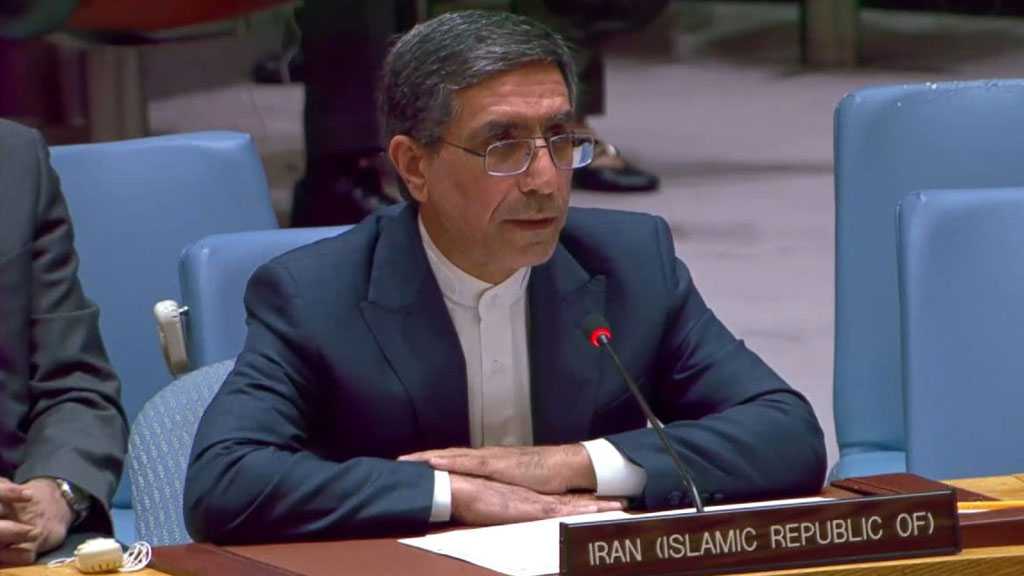
Iran has accused the United States and its allies of exploiting United Nations Security Council mechanisms to advance political objectives against other countries.
Gholamhossein Darzi, Iran’s ambassador and chargé d’affaires to the United Nations, made the remarks Thursday during a UN General Assembly meeting discussing Russia and China’s vetoes of a US-backed resolution concerning Iran.
On September 17, the Security Council failed to approve a resolution extending the mandate of a UN Panel of Experts tasked with monitoring sanctions reimposed on Iran under the so-called snapback mechanism. The measure received 11 votes in favor, two against from China and Russia, and two abstentions.
Darzi condemned Washington’s effort to revive the panel as politically motivated and lacking a legal basis. He described the Russian and Chinese vetoes as necessary actions to defend the UN Charter, international law and the authority of the Security Council.
The Iranian diplomat accused the United States and its allies of repeatedly manipulating the council’s procedures to pursue what he called narrow political agendas, urging the body to reject the politicization of its mechanisms.
Darzi also blamed the current tensions surrounding Iran’s nuclear program on the US withdrawal from the 2025 nuclear agreement, the failure of European countries to fulfill their commitments and what he described as subsequent US-“Israeli” military aggression against Iran.
He rejected allegations that Iran has sought to divert its nuclear program toward military purposes, calling such claims a narrative first promoted by the “Israeli” regime and subsequently repeated by Washington and several European governments.
Darzi stressed that Iran has been a party to the Nuclear Non-Proliferation Treaty [NPT] since 1970 and has been subject to extensive International Atomic Energy Agency [IAEA] monitoring for decades. He contrasted this with what he described as international support for the nuclear-armed “Israeli” entity.
He further argued that Washington lacks the legal and moral standing to accuse Tehran of violating non-proliferation principles while, in his view, engaging in actions that undermine those same principles.
Darzi called on the UN Security Council and General Assembly not to become venues where, as he put it, an aggressor can punish its victim, distort facts or create legal justifications for unlawful actions.
According to the Iranian account, the United States and the “Israeli” entity have launched two major military campaigns against Iran, with the first lasting 12 days in June 2025 and the second beginning on February 28, 2026, before a temporary ceasefire was reached in early April.
Iran maintains that its resistance and retaliatory operations in both conflicts ultimately forced the opposing sides to accept ceasefires.
Comments
- Related News