Bibi’s New “Security Doctrine” Draws Fierce Backlash as Opposition Exposes “Israel’s” Strategic Failures
By Staff, Agencies
“Israeli” Prime Minister Benjamin Netanyahu has unveiled a new "national security" doctrine centered on preemptive military strikes, expanded deterrence, and buffer zones along “Israel’s” borders, prompting fierce criticism from opposition leaders who dismissed the document as a collection of empty slogans designed to conceal the government’s security failures.
Published just nine days before “Israel’s” October 27 parliamentary elections, the three-page document outlines 10 principles that Netanyahu presents as the foundation of a revised security strategy following years of regional conflict and mounting criticism of his government’s military and political decisions.
Opposition leader Yair Lapid ridiculed the document as “superficial” and “bizarre,” comparing its quality to something written by a free artificial intelligence chatbot.
Gadi Eisenkot, a former “Israeli” army chief of staff and leader of the opposition “Yashar” party, was equally dismissive, describing the document as “empty pages filled with slogans” and accusing Netanyahu of leaving a “strategic vacuum” in the entity’s security policy.
The doctrine’s publication comes as Netanyahu seeks another term amid continuing scrutiny of his government’s handling of the security failures surrounding the October 2023 Hamas-led Operation Al-Aqsa Flood and the devastating wars that followed across the region.
Opposition figures accuse the prime minister of exploiting security threats for electoral advantage while avoiding accountability for the failures that preceded the October 2023 events.
Titled Prime Minister Benjamin Netanyahu’s Security Doctrine, the document was published on the “Israeli” government’s website and prepared with assistance from the “National Security” Council.
In its introduction, Netanyahu claimed that military operations in Gaza, Lebanon, Yemen and Iran had eliminated an imminent nuclear threat and dismantled an Iranian-led network that he said had surrounded “Israel.”
He presented these claimed achievements as justification for shifting away from a strategy based primarily on containment and defense toward preemptive attacks against emerging threats.
The document calls for stronger military deterrence, expanded intelligence capabilities, improved early-warning systems and strikes against potential adversaries before they can carry out operations.
It also proposes establishing buffer zones along “Israel’s” borders whenever deemed necessary, without specifying their precise locations or explaining how such measures would affect neighboring territories and the populations living there.
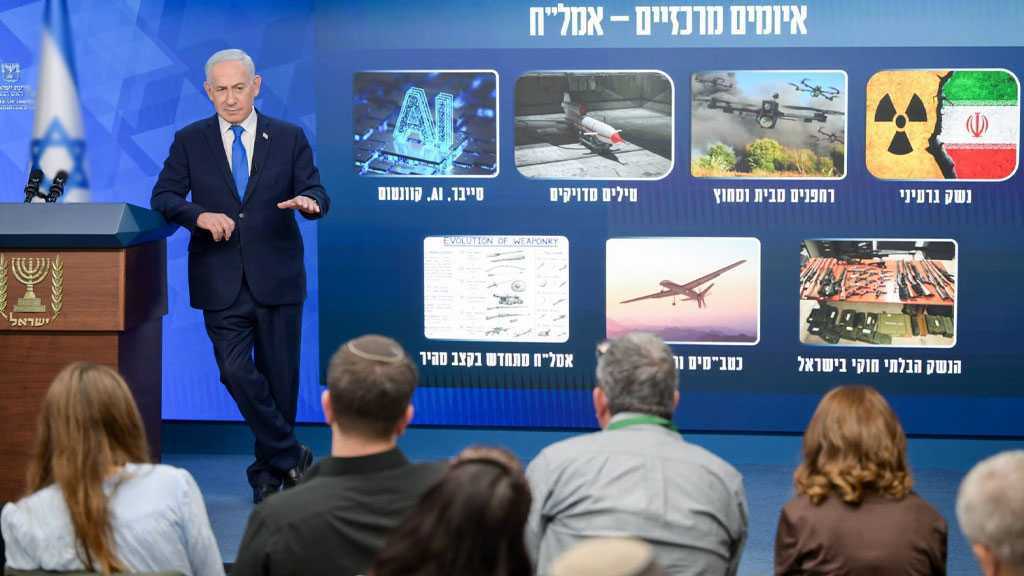
Iran and regional groups allied with Tehran, including Hezbollah in Lebanon and Yemen’s Ansarullah movement, feature prominently in Netanyahu’s assessment of perceived threats. The document also identifies precision-guided missiles, drones, cyberattacks and international efforts to challenge “Israel’s” “legitimacy” as security concerns.
Beyond military operations, the doctrine advocates maintaining military superiority, expanding domestic weapons production to reduce dependence on foreign suppliers and investing in advanced technologies such as artificial intelligence, quantum computing and space capabilities.
It also promotes settlement in territories Netanyahu refers to as the “Land of ‘Israel,’” while emphasizing unity and the expansion of regional partnerships.
However, the document provides few operational details explaining how its proposed measures would be implemented, particularly regarding potential strikes against Iran and the establishment of buffer zones. This lack of concrete planning has fueled criticism that the doctrine prioritizes political messaging over a clearly defined security strategy.
Its calls for unity and stronger international alliances have also drawn scrutiny amid accusations that Netanyahu’s policies have deepened internal divisions and strained “Israel’s” international relations.
During the presentation, Netanyahu displayed maps illustrating what his government considers the principal geopolitical threats and regional alignments.
One map, bearing the logo of Germany’s Friedrich Ebert Foundation, grouped Turkey, Saudi Arabia, Egypt and Pakistan under the label “Sunni Diamond Alliance.” Other classifications included Iran and allied groups under the “Axis of Resistance,” alongside a grouping involving “Israel” and the United Arab Emirates.
The presentation did not establish that every country shown was considered an adversary, nor did the labels demonstrate the existence of formal military alliances among the countries depicted.
Netanyahu has frequently used maps and visual presentations to communicate his assessment of regional threats and military achievements. His critics argue that this approach can simplify complex geopolitical realities and amplify perceptions of danger to reinforce his image as a strong security leader.
Lapid argued that the new doctrine offered little beyond general declarations and failed to address Netanyahu’s responsibility for the entity’s previous security failures.
He also criticized the prime minister for refusing to establish an official commission of inquiry into the failures surrounding the October 2023 operation and challenged his record on expanding normalization agreements with Arab countries.
Lapid pointed to what he described as contradictions between the doctrine’s stated principles and Netanyahu’s policies, including exemptions from military service for ultra-Orthodox Jews, deteriorating international relations and growing divisions within “Israeli” society.
Eisenkot similarly argued that the document reflected the strategic vacuum created by Netanyahu’s leadership, accusing the prime minister of releasing it shortly before the election to divert attention from his government’s record.
He further accused Netanyahu of manipulating public perceptions, exploiting fear and distracting voters from controversies involving dishonesty and racism during the election campaign.
Challenging Netanyahu’s claims of military success, Eisenkot argued that Hamas continued to maintain armed forces in Gaza while Hezbollah was rebuilding its capabilities in Lebanon.
He also accused the prime minister of failing to achieve key wartime objectives and continuing to resist a full investigation into the security failures that preceded the October 2023 operation.
Eisenkot pledged that an opposition-led government would develop and formally approve a comprehensive national security strategy within 150 days of taking office.
The dispute highlights growing political divisions as Netanyahu and opposition parties compete for power ahead of the parliamentary elections, with military accountability, regional confrontation and “Israel’s” international standing emerging as central campaign issues.
Ultimately, the controversy surrounding the doctrine reflects a broader struggle over Netanyahu’s security record. While the prime minister presents continued military pressure and preemptive action as essential to protecting “Israel,” his opponents argue that years of warfare have failed to deliver lasting security and that sweeping declarations cannot substitute for accountability, coherent strategy and a political approach capable of addressing the roots of regional conflict.