Princes, Thieves and Billions: The Secret Plot to Remake the Middle East
By Mohamad Hammoud
Matthew Cole’s investigation describes how Gulf rulers used secret accounts, covert operations, and Jared Kushner’s White House access to advance their ambitions against Iran, strengthen “Israel” and sideline Palestinian sovereignty.
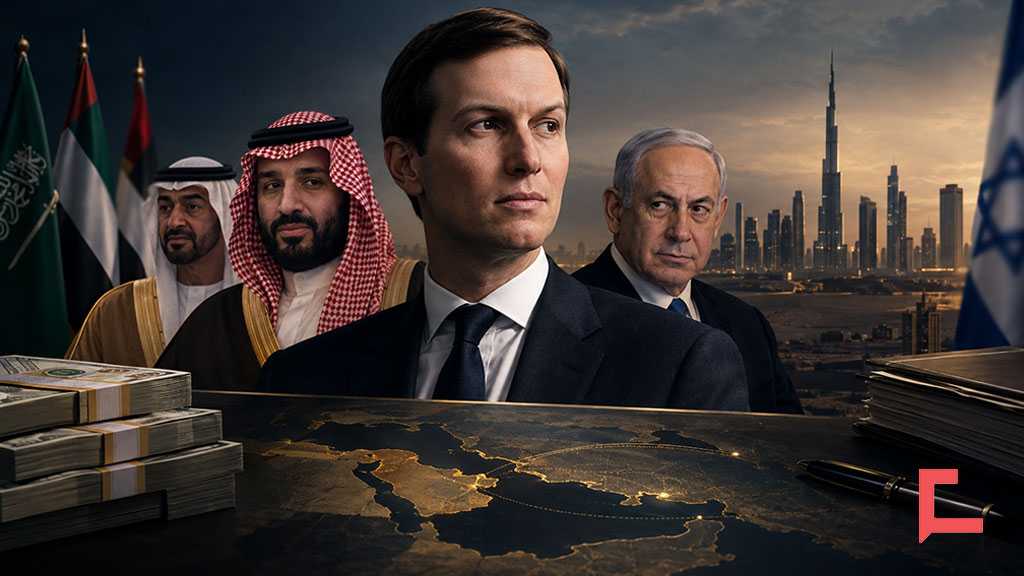
Donald Trump promised to put America first. Yet an explosive investigation describes how his son-in-law Jared Kushner became the intermediary in a multibillion-dollar arrangement connecting Saudi Arabia, the United Arab Emirates and “Israel.”
The Money Behind the Diplomacy
In an October 22 Vanity Fair investigation adapted from Princes and Thieves, journalist Matthew Cole reports that Mohamed bin Zayed and Mohammed bin Salman discussed establishing a fund exceeding $10 billion with Jared Kushner to advance their objectives through Washington, including promoting Emirati priorities with Trump.
The arrangement was intended to remain secret, but the first clues emerged in 2017, when Dutch intelligence learned that a Russian GRU hacker was traveling to Britain. Working with British authorities, Dutch operatives persuaded the hacker to become a double agent, gaining access to a Russian intelligence server containing screenshots from
Kushner’s Compromised iPhone.
That discovery led investigators to a broader financial network. By 2018, Dutch investigators had reverse-engineered the intrusion and were monitoring Kushner as he accessed a UAE bank account receiving hundreds of millions of dollars through Azerbaijan. Cole also describes transfers to a warlord, a mercenary, and a former contract killer, connecting the financial dealings to covert operations beyond Washington.
Secret Accounts, Mercenaries and Netanyahu
Cole identifies the account as Alpha, held at First Abu Dhabi Bank through the government-funded Watani Al Emarat Foundation, where approximately $750 million flowed in and Kushner was granted signing authority. The account was linked to covert Emirati arms purchases and overseas operations, including an $85 million transfer to Libyan commander Khalifa Haftar and financing connected to mercenary networks associated with Blackwater founder Erik Prince.
But the allegations did not end with Emirati operations. A separate account, identified as Beta, brought Netanyahu directly into the financial network. Cole reports that bin Zayed transferred approximately $1 billion through Azerbaijan into an account at the Bank of “Israel”. According to a source familiar with the arrangement, Netanyahu encouraged Kushner to deposit the money there, making funds intended for Kushner personally appear to be government deposits.
Netanyahu’s involvement did not end there, as he also demanded notification before withdrawals, with communications passing through Ambassador David Friedman. Cole describes funds subsequently moving into accounts in Cyprus, while a separate account of the transactions identifies a $50 million transfer described as a personal payment.
Remaking the Middle East
Mohammed bin Salman, Mohammed bin Zayed, and Netanyahu shared a common ambition: confronting Iran and bringing Arab governments closer to “Israel”, although each pursued his own interests. Bin Salman sought American backing to consolidate his leadership and challenge Tehran, while bin Zayed wanted Washington to abandon the Iran nuclear agreement, a goal Netanyahu shared. Kushner’s close relationship with Trump gave them a direct channel to the White House, advancing normalization and an “Israeli”-Palestinian settlement favorable to Netanyahu.
Their cooperation also extended into military planning, with Cole describing a third account intended to finance emergency “Israeli” military assistance to the UAE in the event of an Iranian attack. This growing partnership helped pave the way for the so-called “Abraham Accords”, allowing Arab-“Israeli” normalization to proceed without Palestinian statehood. Kushner’s peace proposal failed to gain Palestinian acceptance, leaving the Palestinian question unresolved until the subsequent war in Gaza brought it back to the center of American diplomacy, with Kushner again involved in regional negotiations.
From Public Office to Private Billions
Kushner’s financial troubles raise further questions about his dealings with Gulf monarchies. His family business faced a looming $1.4 billion mortgage payment on 666 Fifth Avenue in Manhattan and sought outside financing, including from investors connected to Qatar. The property was eventually rescued through a long-term lease with Brookfield, whose real estate business had received investment from Qatar’s sovereign wealth fund. After leaving the White House, Kushner established Affinity Partners, which secured a $2 billion investment from Saudi Arabia’s sovereign wealth fund.
These financial connections also raise questions about government oversight, particularly after four senior Trump administration officials told Cole they knew of no presidential authorization for Kushner’s access to foreign government accounts.
Kushner and Ambassador David Friedman have denied the reported arrangements, but Cole’s investigation raises a larger question: whose interests were being served when American diplomacy became entangled with secret foreign financing?
Trump promised to put America first, yet the investigation raises the possibility that private financial interests and Netanyahu’s regional ambitions took precedence over the interests of the American public.