IRGC Navy: Two Oil Tankers Explode After Striking Mines in Strait of Hormuz
By Staff, Agencies
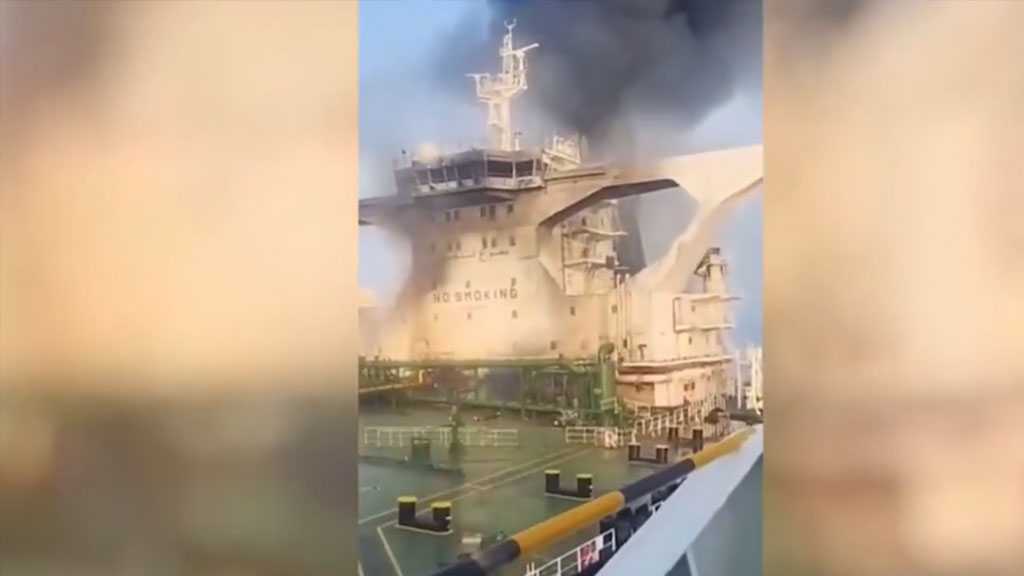
The Public Relations Office of the Islamic Revolution Guards Corps [IRGC] Navy has announced that two oil tankers exploded after striking naval mines while attempting to navigate an unauthorized route through the Strait of Hormuz, in violation of established maritime regulations.
According to a statement released on Sunday night, one of the vessels is a supertanker that remains engulfed in flames following a powerful explosion. The incident occurred as the vessel attempted to pass through the restricted southern route.
The IRGC Navy stated that both tankers had deliberately switched off their navigation and identification systems in an apparent attempt to transit covertly. It further said that the vessels were operating with the support and encouragement of the terrorist US military. Following the explosions, both vessels were brought to a halt at the scene.
The IRGC Navy emphasized that the tankers had disregarded repeated warnings and entered dangerous waters in direct violation of regulations governing passage through the strategic waterway. It held the vessels’ owners fully responsible for the consequences, stressing that they had chosen to disregard established safety protocols and attempt unauthorized passage.
The latest incident comes amid what Iranian military officials describe as a continuing pattern of violations in the Strait of Hormuz. In recent weeks, several tankers, including supertankers carrying substantial quantities of crude oil, have reportedly suffered explosions and fires while attempting to use the same unauthorized southern route. These vessels allegedly disabled their identification systems and operated with US military encouragement.
Iranian forces have repeatedly warned that any vessel attempting to transit the waterway without prior coordination or while deliberately deactivating its identification systems will be regarded as a threat and face a firm response.
Since the beginning of what Iran describes as the unprovoked US-”Israeli” war of aggression against the Islamic Republic on February 28, the IRGC Navy has maintained what it describes as full operational and intelligence control over the Strait of Hormuz and the Gulf.
Iranian authorities maintain that all commercial maritime traffic must obtain prior authorization and comply with designated routes coordinated with the relevant Iranian authorities.
They have warned that unauthorized movements, particularly those supported by the United States, pose a serious threat to maritime security and will be confronted by defensive measures deployed to protect the strategic waterway.
Iranian military officials have also dismissed US claims that the Strait of Hormuz has been reopened or cleared of naval mines, describing such statements as baseless propaganda that fails to reflect the situation on the ground.
Despite Washington’s extensive naval presence in the region, Iranian officials maintain that US forces have failed to guarantee safe passage for vessels operating outside arrangements established by Tehran, arguing that American attempts to challenge Iranian control have repeatedly ended in failure.
The IRGC Navy has reiterated that the Strait of Hormuz remains under the sovereign authority of the Islamic Republic, insisting that safe and orderly maritime passage is available to vessels that coordinate in advance and comply with Iranian regulations.
The force has further warned that any continued provocative or unauthorized activity in the strategic waterway will be met with an immediate and proportionate response.