When the World Walked Out
By Mohamad Hammoud
Netanyahu, the United Nations and the Fading Power of an Old Defense
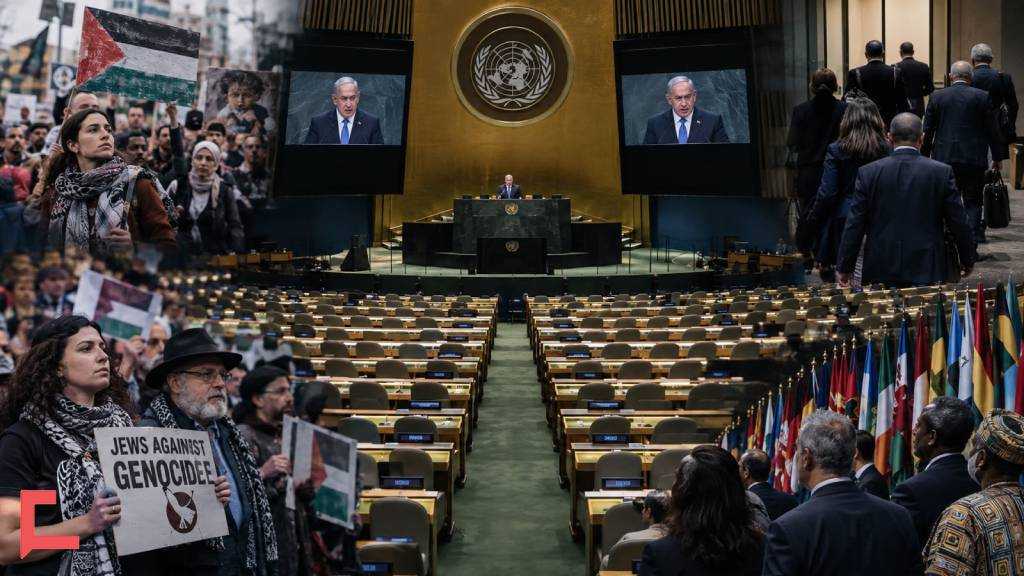
Benjamin Netanyahu had barely taken the stage at the United Nations General Assembly when the chamber delivered a message more powerful than diplomatic language. According to Foreign Policy, more than 100 UN delegates rose from their seats and walked out as the “Israeli” prime minister prepared to speak. Reuters likewise reported delegates streaming from the hall in protest. The departure carried neither the force of a resolution nor the weight of sanctions, but its symbolism was unmistakable: after years of watching Gaza consumed by war, diplomats representing countries across the world were prepared to stand up and turn their backs.
The scale of Palestinian suffering formed the unavoidable backdrop. Reuters reported this week that more than 73,000 Palestinians have been killed in Gaza since October 2023, according to Gaza health officials, with the toll including civilians and combatants. For nearly three years, the world has watched images of destroyed neighborhoods, grieving families and children pulled from rubble. Against that history, the walkout appeared less like an ordinary diplomatic protest than the expression of a breaking point.
A Protest Beyond the Arab World
The breadth of that rejection made the moment even more significant. Arab and Muslim delegations were among those opposing Netanyahu, but the protest extended far beyond the Arab and Islamic worlds. Countries identified among those absent or participating stretched across continents and political traditions: Spain and Slovenia in Europe; Brazil, Chile, Colombia, Peru, Bolivia and Cuba across Latin America and the Caribbean; and South Africa and Kenya in Africa.
That diversity matters. Netanyahu could not easily reduce what happened to the familiar narrative of “Israel” surrounded by hostile Arab or Muslim states. The people leaving the chamber came from societies separated by geography, religion, culture and history. What connected them was not ethnicity or faith, but growing international opposition to the conduct of Netanyahu’s administration.
Netanyahu responded by calling those leaving “moral cowards,” Foreign Policy reported. But the insult could not erase the image. The diplomats had already answered him with their feet.
When Antisemitism Becomes a Shield
For years, Netanyahu has repeatedly invoked antisemitism when confronting fierce criticism of “Israeli” policy. Antisemitism is real, dangerous and historically catastrophic, and hatred of Jews because they are Jewish must be confronted without hesitation. But opposition to occupation, bombardment or the policies of Netanyahu’s administration is not inherently hatred of Jews.
That distinction is becoming increasingly difficult to blur because many of those challenging Netanyahu are themselves Jewish.
As Netanyahu arrived at the United Nations, hundreds demonstrated outside in a protest led by Jewish Voice for Peace and allied organizations. Jewish Voice for Peace reported that the majority of roughly 400 participants were Jewish, joined by Palestinian, Lebanese and Iranian New Yorkers. Among them were rabbis, Jewish activists and descendants of Holocaust survivors. More than 100 protesters were arrested.
Jewish Voice for Peace also reported that more than 200 rabbis recently signed a letter urging members of Congress to support legislation restricting shipments of certain American weapons to “Israel.” Whatever one thinks of their political position, their existence exposes the fundamental weakness in equating opposition to Netanyahu with hostility toward Jews. Jews are not Netanyahu, Judaism is not the “Israeli” entity, and criticism of a state cannot automatically be transformed into hatred of a religion or people.
When the Accusation No Longer Ends the Debate
That may be the deeper significance of the UN walkout. The accusation of antisemitism still carries enormous moral weight, and genuine antisemitism remains a serious danger. But the accusation cannot by itself settle a debate over Gaza, occupation or administration policy.
Something has changed when more than 100 delegates can rise together and leave rather than remain politely seated. Something has changed when Jewish protesters gather outside the same building to condemn policies carried out by an entity claiming to represent Jewish security.
The defining image of Netanyahu’s appearance, therefore, may not be anything he said. It was the moment people stopped listening.
After years of death, destruction and images from Gaza that have traveled around the world, more than 100 delegates stood up and walked away. The empty seats delivered the message Netanyahu could not control: condemnation of his administration crosses continents, religions and cultures, and calling its critics antisemitic can no longer make that condemnation disappear.