From a House of Peace to a Podium of Threats
By Mohamad Hammoud
The Purpose of the United Nations
The United Nations was born from catastrophe. After two world wars had devastated continents, its founders sought to construct an international system in which disputes between nations would be settled through diplomacy rather than destruction. The UN Charter defines its central purpose: maintaining international peace and security, preventing threats to peace and bringing disputes toward settlement by peaceful means.
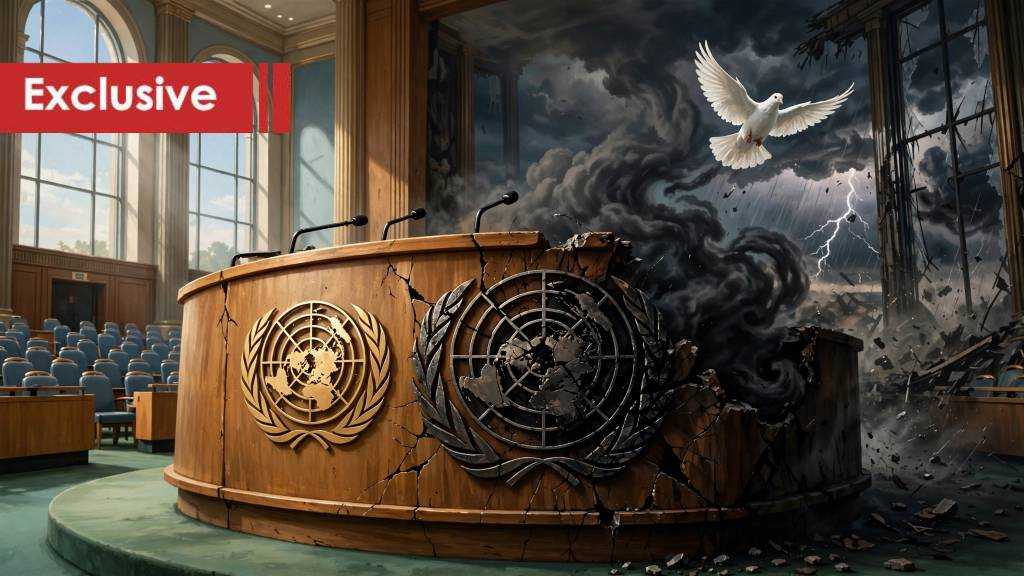
Against that history, President Donald Trump’s address to the 81st United Nations General Assembly on September 22 presented a striking contradiction. Standing at the podium of an institution created to prevent war, the president of one of its most powerful member states threatened another member state with annihilation.
Trump has threatened Iran with military force on numerous occasions. The threat itself was hardly novel. What was different this time was the venue. After years of threatening Tehran, Trump had now brought the threat into the very chamber established to keep nations from threatening one another with destruction.
Trump asked whether a deal would be reached with Iran or whether he would “annihilate the Islamic Republic.” The language was remarkable because the UN Charter calls upon states to refrain from the threat or use of force against other states.
The contrast raises a larger question: Which country’s historical record better fits the image of the habitual international aggressor?
The Record Behind the Rhetoric
For decades, Washington has portrayed Iran as a principal source of instability and aggression in the Middle East. Yet the historical record tells a markedly different story.
Iran has provided military, financial and political assistance to allied movements and governments across the region, often in conflicts involving resistance to foreign occupation or governments confronting armed threats. Hezbollah emerged amid “Israel’s” invasion and occupation of Lebanon and built much of its legitimacy around resistance to that occupation. In Syria, Iran intervened in support of President Bashar al-Assad’s government after Damascus requested assistance. In Iraq, Iran supported forces fighting the Islamic State.
The Islamic Republic’s defining conventional interstate war was the Iran-Iraq War of 1980–1988, which began with Iraq’s invasion of Iran in September 1980. UN Secretary-General Javier Pérez de Cuellar later identified Iraq’s armed attack and subsequent occupation of Iranian territory as the violation that bore responsibility for initiating the conflict.
Those policies stand in sharp contrast to the history of direct American military intervention around the world.
A Congressional Research Service report documents hundreds of instances in which US armed forces were used abroad. One analysis of the data counted 469 US military interventions between 1798 and 2022, including 251 since the end of the Cold War in 1991.
Since World War II alone, American forces have fought in Korea and Vietnam, invaded Grenada and Panama, waged major wars in Afghanistan and Iraq, bombed Yugoslavia and Libya and conducted military operations across numerous other countries. Washington’s reach has extended beyond conventional warfare. The United States has used covert operations to influence political outcomes abroad, including the CIA-backed 1953 operation that overthrew Iranian Prime Minister Mohammad Mossadegh.
The contrast is difficult to ignore. If aggression is measured by military interventions, invasions, bombings, occupations and operations beyond national borders, the record turns Washington’s accusation against Iran on its head. By those measures, it is the United States-not Iran- that has repeatedly carried war and military force across borders on a global scale. Washington’s own record therefore raises the very charge of aggression it has spent decades directing at Tehran.
When the Podium Becomes a Warning
The contradiction came into sharp focus inside the General Assembly itself. The UN was created to prevent powerful states from settling international disputes through threats and force. Yet from its podium came a threat to annihilate another member state.
The irony is difficult to escape. An institution born from the devastation of war became the stage from which one of its most powerful members threatened another with destruction. And the threat came from a country whose own record of invasions, bombings, occupations and military interventions speaks louder than the accusations it directs at Iran.
The United Nations was created precisely because humanity had already learned where the language of annihilation can lead.
Comments