Oil Tanker Catches Fire After Drone Attack off Russia’s Black Sea Coast
By Staff, Agencies
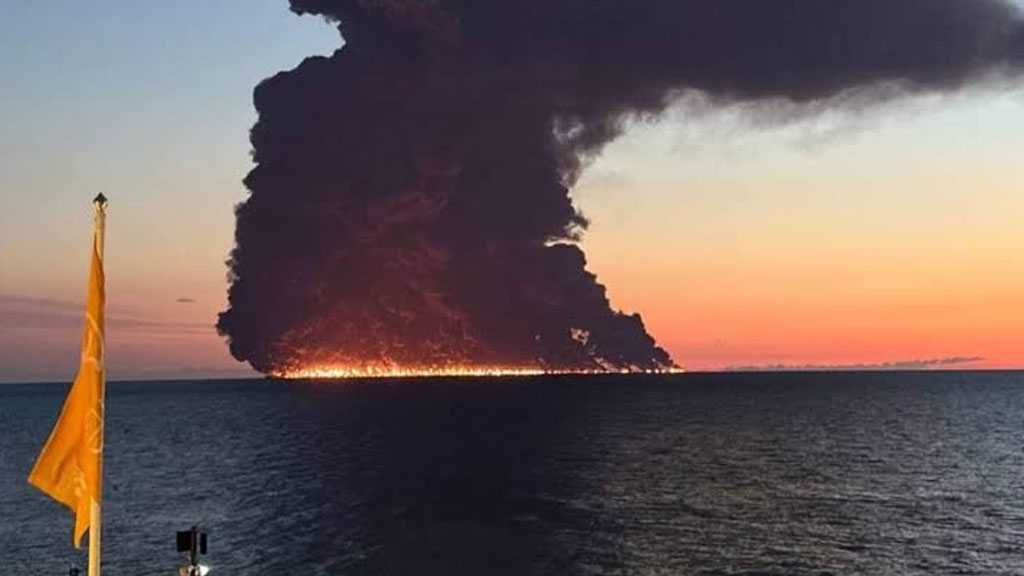
An oil tanker carrying crude caught fire off Russia’s Black Sea coast after being struck by unmanned surface vessels near Sochi, according to Russia’s Transport Ministry.
The 23-member crew, all Indian nationals, was safely evacuated from the Liberia-flagged Aframax Rio, with no injuries reported.
The ministry said the tanker came under attack from sea drones on Tuesday, triggering a major fire in the Black Sea. The intensity of the flames initially prevented emergency responders from approaching the vessel.
Russian Transport Minister Andrey Nikitin ordered the establishment of an emergency response headquarters as authorities mobilized personnel and equipment to contain the incident and address its potential environmental consequences.
As a precaution, authorities temporarily closed beaches in the nearby federal territory of Sirius, next to Sochi. Local officials later reported that monitoring detected pollutant concentrations below permitted levels and that there was no immediate threat to public health.
The tanker incident came amid a separate series of attacks involving commercial vessels in the Black Sea.
On Tuesday, two merchant ships were reportedly struck by unidentified naval and aerial drones inside Bulgaria’s exclusive economic zone, around 128 kilometers from the Bulgarian coast.
The Togo-flagged Alfa Watan sustained critical damage and sank, while the Palau-flagged Able caught fire. Eighteen members of the Able’s crew were rescued, with two suffering serious injuries. One of the crew members said the vessel was transporting Ukrainian cargo.
Bulgarian Prime Minister Rumen Radev condemned the attacks as a “blatant violation of international law and maritime law,” warning that continued attacks were placing additional pressure on Black Sea commercial shipping and increasing insurance costs.
No party has claimed responsibility for the attacks.
The incidents come against the backdrop of an expanding maritime and aerial confrontation between Russia and Ukraine, with Moscow targeting vessels it says are transporting military or dual-use cargo toward Ukrainian Black Sea ports.
The Russian Defense Ministry has also warned that Ukrainian President Vladimir Zelensky would bear “full personal and political responsibility” for any further escalation.
Ukraine, meanwhile, has significantly increased attacks against Russian energy infrastructure and commercial shipping in the Black Sea and Sea of Azov. Ukrainian forces have increasingly relied on combinations of naval and aerial drones to target vessels associated with Russian ports and energy networks.
Zelensky vowed over the weekend to intensify attacks on Russian oil refineries. Moscow subsequently said it would broaden strikes against Ukrainian military-industrial facilities and related infrastructure.
The expanding attacks on energy infrastructure are also having repercussions beyond the immediate conflict zone, with the disruption becoming a factor in international fuel markets.
US President Donald Trump said Monday that rising gasoline prices in the United States were increasingly being driven by attacks on Russian refineries rather than disruptions around the Strait of Hormuz.
“What’s driving up gasoline is no longer the Strait of Hormuz,” Trump wrote, arguing instead that Russian refineries “are being blown up by Ukraine.”
Trump had previously called on Zelensky to “stop knocking out diesel fuel in Russia,” arguing that the campaign was “hurting the world.”
US Treasury Secretary Scott Bessent has likewise pointed to Ukrainian strikes against Russian energy infrastructure and refined petroleum products as contributing to what he described as a broader “energy shock.”
The latest maritime attacks underscore the widening geographic and economic consequences of the Russia-Ukraine conflict, as commercial shipping, energy infrastructure and international fuel markets increasingly become entangled in the expanding confrontation.