Pezeshkian: Iran Will Not Bow to Coercion or Accept Imposed Demands
By Staff, Agencies
Iranian President Masoud Pezeshkian has reaffirmed that Tehran will not yield to pressure or accept demands imposed by foreign powers, stressing that the Islamic Republic will continue to defend its rights in accordance with international law.
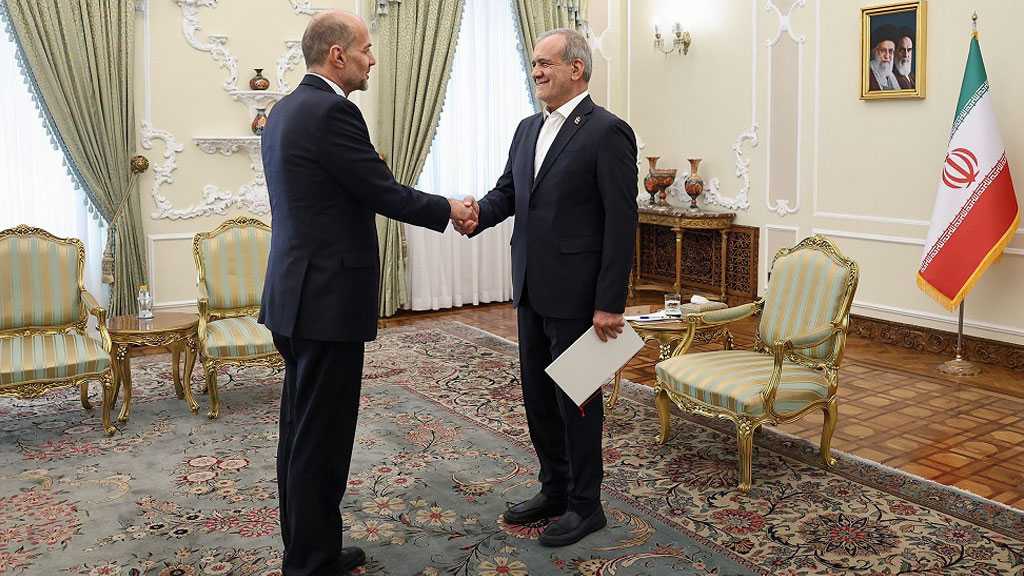
Pezeshkian made the remarks on Tuesday during separate meetings with the newly appointed ambassadors of Portugal, Switzerland, Turkey and Nigeria, who presented their credentials in Tehran.
During his meeting with Portuguese Ambassador Waltier Matias, the president criticized what he described as misleading representations of Iran and its people in Western media.
“Many of the things published about Iran and our nation in Western media do not correspond to reality,” he said.
Pezeshkian also condemned state terrorism and the targeting of scientists, schoolchildren and political leaders across the region by the United States and the “Israeli” entity.
“Those responsible for these actions claim to be fighting terrorism while committing such crimes. This is one of the bitter realities of today’s world that we are facing,” he stated.
Emphasizing Iran’s commitment to peace and stability, the president said Tehran seeks to play a constructive role in regional and international affairs but will not surrender to pressure or intimidation.
“We will not yield to force, and we will defend our rights within the framework of international laws and regulations. No country can impose any demands on the Iranian nation outside this framework,” Pezeshkian stressed.
He added that establishing relations between countries on the basis of rights, justice and fairness would help prevent conflicts and wars.
In his meeting with Swiss Ambassador Georg Steiner, Pezeshkian commended Switzerland’s positions on international affairs, particularly its humanitarian initiatives and efforts to promote global peace.
“Switzerland’s positions in these areas are worthy of respect, and we hope that, by making use of the existing capacities, the ground will be prepared for expanding relations and joint cooperation between the two countries in all fields,” he said.
The president also expressed hope that Steiner would become more familiar with Iranian society, including its historical heritage, rich culture and civilization throughout his diplomatic assignment.
He said the Swiss envoy could contribute to presenting a more accurate picture of Iran to the international community by highlighting realities on the ground and countering what he described as false propaganda and distorted portrayals of the country.
Meeting with Turkish Ambassador Ahmed Aydin Dogan, Pezeshkian highlighted the longstanding friendship and historical ties between Iran and Turkey.
“Iran and Turkey have close and brotherly relations, which are fortunately expanding day by day. The Islamic Republic of Iran’s approach toward Turkey and other neighboring countries is based on brotherhood and mutual respect,” he said.
He pointed to the extensive cultural, religious and ethnic bonds shared by the two neighboring nations, describing them as important foundations for further cooperation.
Addressing regional developments, Pezeshkian accused the “Israeli” regime of pursuing its objectives through crimes, genocide and attempts to sow division among Islamic countries.
“Today, the ‘Israeli’ regime is pursuing its objectives by committing crimes and genocide and seeking to create division and rifts among Islamic countries. Its objectives are not directed at just one country but encompass all Islamic countries,” he said.
The president further stated that the regime continued its actions with the backing of the United States and certain European countries, while much of the international community remained a spectator to its actions.
Referring to the military aggression against Iran, Pezeshkian said those responsible had initially calculated that military action and war would lead to the collapse of the Islamic Republic, but had failed to achieve their intended objective.
“Now they are seeking to put the Iranian nation under pressure through economic measures. However, the Islamic Republic of Iran possesses considerable capacities and capabilities, and such pressures cannot break the will of the Iranian nation,” he stated.
Recalling his remarks at a four-way meeting of regional security officials, Pezeshkian once again called for greater unity, convergence and cooperation among Muslim countries.
“If the countries of the region stand alongside one another with understanding, unity and cohesion and help each other secure their common security and interests, the ‘Israeli’ regime will not be able to achieve its objectives and intentions in the region,” he said.
In a separate meeting with Nigerian Ambassador Hamza Mohammad Slao, the Iranian president expressed Tehran’s readiness to strengthen bilateral relations and expand cooperation with Abuja.
“The Islamic Republic of Iran is ready to make use of all available capacities to develop relations with Nigeria and welcomes any initiative or effort in this direction,” Pezeshkian said.
He also emphasized that countries genuinely committed to peace, stability and security in the region must reconsider their approaches toward other nations and pursue relations based on mutual respect and cooperation.
Comments