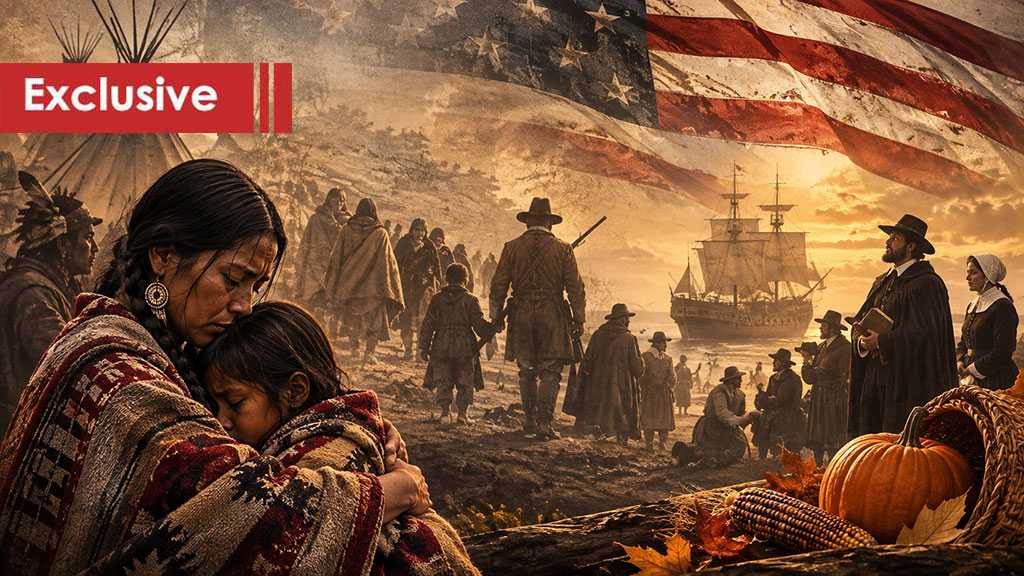
Thanksgiving: When One People’s Celebration Is Another People’s Mourning
By Mohamad Hammoud
A Celebration Built on a Forgotten Tragedy
Imagine welcoming strangers into your homeland, feeding them when they are hungry and teaching them how to survive, only for later generations of those newcomers to confiscate your lands, slaughter your people, forcibly remove your children and attempt to erase your cultural identity. Then imagine their descendants celebrating a national holiday commemorating that original encounter.
For many Indigenous Americans, however, this is not an imaginary tragedy but a painful historical reality that gives Thanksgiving a profoundly different meaning. While millions of Americans gather around dinner tables today, November 26, to celebrate prosperity and express gratitude, many Indigenous people mourn the devastating consequences of colonization.
Thus, what American popular culture celebrates as a symbol of friendship evokes, for many descendants of those who extended that friendship, memories of persecution, dispossession and generations of suffering.
From Indigenous Hospitality to Demographic Catastrophe
When the Pilgrims arrived in 1620, nearly half died during their first winter.
According to the Smithsonian’s National Museum of the American Indian, the Wampanoag helped the newcomers survive by sharing agricultural knowledge and establishing an alliance. Yet cooperation eventually gave way to colonial expansion, warfare, enslavement and displacement.
A 2019 study published in Quaternary Science Reviews estimated that approximately 56 million Indigenous people across the Americas died between 1492 and 1600, representing roughly 90 percent of the Indigenous population. While introduced diseases accounted for much of this catastrophe, colonial violence, famine and exploitation compounded the devastation.
Nor did American independence end Indigenous persecution. On the contrary, dispossession became entrenched in federal policy through measures such as the Indian Removal Act of 1830, which facilitated forced expulsions, resulting in thousands of deaths during migrations, most notably the infamous Trail of Tears.
Through military campaigns, broken treaties and territorial confiscations, the expanding American state thus perpetuated colonial injustices, undermining Indigenous sovereignty and depriving generations of their ancestral inheritance.
Stolen Children and Forgotten Graves
The assault on Indigenous existence, however, extended beyond territorial conquest. Washington pursued forced assimilation by separating Indigenous children from their families and confining them to boarding schools, many administered by Christian religious institutions. There, children were forbidden from speaking their native languages, stripped of their cultural identities and subjected to physical, psychological and sexual abuse.
In July 2024, the US Department of the Interior reported at least 973 Indigenous child deaths and identified 74 marked and unmarked burial sites associated with boarding schools. Yet a December 2024 investigation by The Washington Post documented more than 3,100 student deaths.
Nor was this institutionalized abuse confined to the United States. Canadian residential schools separated more than 150,000 Indigenous children from their communities. Canada's National Centre for Truth and Reconciliation has documented thousands of deaths, while investigations into suspected unmarked graves continue.
Consequently, many Indigenous parents were robbed not only of their children but also of the dignity of knowing where they were buried.
An Injustice That Never Ended
The consequences of these historical injustices remain visible in Indigenous communities confronting poverty, inadequate housing, unemployment, addiction and limited access to healthcare. Rather than adequately addressing these inequalities, Washington has repeatedly failed to fulfill its obligations toward Indigenous communities, as documented by the US Commission on Civil Rights in its 2018 report, Broken Promises, which exposed persistent federal underfunding of essential services.
Against this backdrop, the US Centers for Disease Control and Prevention has documented disproportionately high drug overdose mortality among American Indians and Alaska Natives, while alcohol-related harm and inadequate access to treatment further compound their suffering. These persistent inequalities, therefore, cannot be separated from generations of dispossession, institutional abuse and government neglect.
A National Day of Mourning
It is this enduring legacy of injustice that has brought Indigenous activists together annually since 1970 in Plymouth, Massachusetts, to observe the National Day of Mourning, challenging America's romanticized Thanksgiving narrative. Their mourning encompasses not merely ancestral lands and lives lost but also stolen childhoods, shattered families, suppressed cultures and persistent inequalities—a historical legacy that stands in stark contrast to America's proclaimed commitment to freedom, justice and human rights.
Thanksgiving, therefore, embodies two profoundly contrasting historical experiences: prosperity and dispossession, celebration and grief, gratitude and remembrance. Yet while millions of Americans celebrate their blessings, the suffering of those whose lands were confiscated, whose children were forcibly taken and whose descendants continue to endure the consequences must not be forgotten.
Ultimately, how can a nation genuinely give thanks for what it has gained while failing to confront the injustices inflicted upon those from whom so much was taken?
Comments