When the Numbers Come with a Narrative: Questions Over Kpler’s Iran Oil Data
By Fatima Haydar
Kpler’s latest assessment of Iranian oil shipments has quickly become part of a broader story about the impact of the US blockade. The headline finding is striking: no crude was recorded as being loaded onto tankers in September. But the more striking question is how much certainty can reasonably be attached to that number.
According to preliminary tanker-tracking data, Iran loaded no crude onto tankers in September, while Kpler and Vortexa reportedly recorded the same result. Bloomberg also reported the figure, while noting that the data was preliminary and based on satellite imagery.
But there is a question that deserves to be asked before these numbers are turned into a headline about Iran’s oil industry collapsing:
Who is producing the data, what assumptions are built into it, and how independent is the analysis behind the numbers?
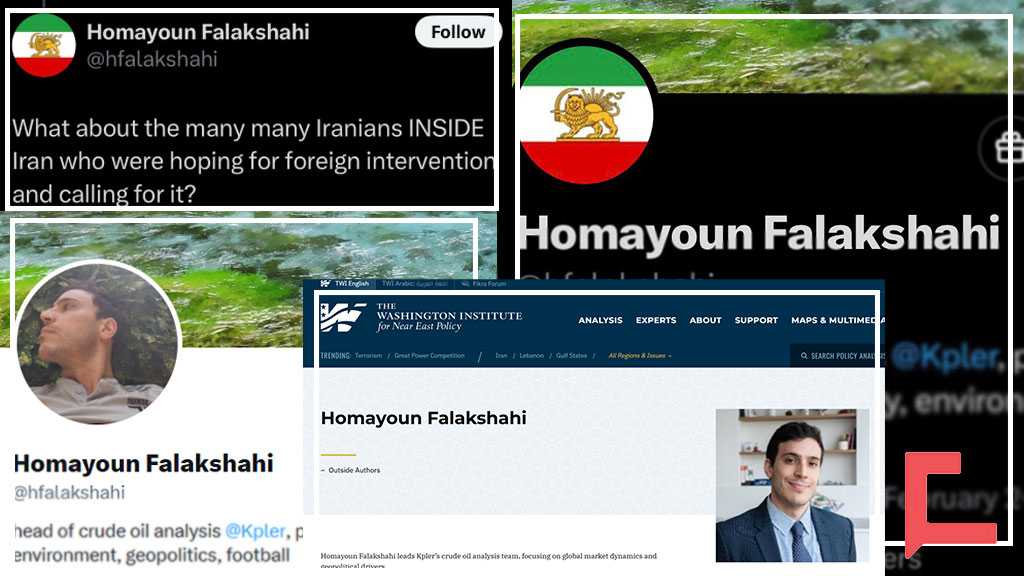
One reason the question has attracted attention is the role of Homayoun Falakshahi, Kpler’s Head of Crude Oil Analysis. He is not simply an outside commentator on Iranian oil. He leads the company’s crude-oil analysis team and has been publicly involved in explaining developments in Iranian oil flows.
Questions have also been raised on social media about Falakshahi’s political sympathies. Several users on X have described him as sympathetic to Iran’s pre-1979 monarchy, pointing in particular to an image formerly used on his X profile that appeared to feature the Pahlavi-era Iranian flag. Some posts also said that the image was later changed after the issue attracted attention.
Falakshahi has also published analysis through The Washington Institute, a US-based Middle East policy organization. The institute describes its work in terms of advancing American interests and promoting a “balanced and realistic understanding” of the region. Its own Iran program describes the Islamic Republic as a major security challenge to the United States and its allies.
None of this establishes that Falakshahi has manipulated Kpler’s figures, and there is no evidence presented here that he has done so. Rather, his public profile and personal political views have prompted additional questions about the independence and framing of analysis concerning Iran.
The September estimate therefore has to be examined on its own terms, particularly whether the methodology is sufficiently transparent for an outside reader to understand how the number was reached.
Kpler is not some anonymous spreadsheet floating around the internet. Its data can have real consequences for markets, governments and public perceptions of what is happening inside Iran. When the same analyst responsible for interpreting Iranian oil flows is also publishing geopolitical analysis through a Washington policy institution whose stated mission is tied to US interests, readers are entitled to ask whether the interpretation surrounding the data deserves the same scrutiny as the data itself.
There is another problem: wartime oil tracking is not a perfect window into reality.
The September figures have been described as preliminary. Iranian tankers can delay or switch off tracking signals, and some oil can move through less visible channels or from floating storage rather than appearing as a conventional new loading at an Iranian terminal. Bloomberg-related reporting has itself noted these limitations.
So “zero recorded loadings” is not necessarily identical to “zero Iranian oil moving.”
That distinction should not be buried beneath dramatic headlines.
The irony is that the very conditions created by the blockade and the war make independent verification more difficult. Ships disappear from tracking systems. Routes change. Cargoes can remain offshore. Storage can substitute for new loadings. And satellite-based monitoring inevitably has blind spots.
Yet in the middle of all this uncertainty, a very simple narrative can emerge:
Iran has no oil exports. The blockade is working. Iran is running out of options.
And that narrative fits neatly into the broader political messaging surrounding the war.
Kpler’s own recent analysis has repeatedly examined the effectiveness of the US maritime blockade and its impact on Iran’s oil flows. One Kpler analysis, written by Falakshahi, described the blockade as increasingly effective and argued that it was becoming Washington’s primary pressure tool.
Again, that does not make the underlying shipping data false.
But it does raise a bigger question about the line between measuring an event and constructing a narrative around it.
Western institutions are often presented as neutral simply because they use sophisticated technology, English-language methodology and the vocabulary of data science. But institutions are made up of people, and people operate within political, professional and institutional environments.
The concern is not necessarily that anyone is fabricating numbers. It is what happens before the number reaches the headline: which signals are counted, which gaps are treated as significant and how much uncertainty is attached to the final estimate.”
That is precisely why Kpler’s Iran data should not be treated as unquestionable simply because it comes with charts, satellite imagery and the appearance of technical precision.
The numbers may be right.
The interpretation may be partly right.
But neither should be treated as politically weightless.
And in a war where the United States and “Israel” have a direct interest in demonstrating that pressure on Iran is succeeding, every major claim about Iran’s economic and military condition deserves to be examined carefully.
The real question, then, is not whether Kpler should be believed or automatically dismissed.
It is whether its figures are being presented with enough transparency about their limitations, their methodology and the assumptions behind their interpretation.
Because when data emerges from the middle of a war, numbers do not exist in a political vacuum.
And when those numbers help tell the story that Washington wants the world to hear about Iran, scrutiny is not optional.
It is necessary.