Washington’s Unintended Admission: The Bill to Destroy Hezbollah Acknowledges the Roots of Its Legitimacy
By Mohamad Hammoud
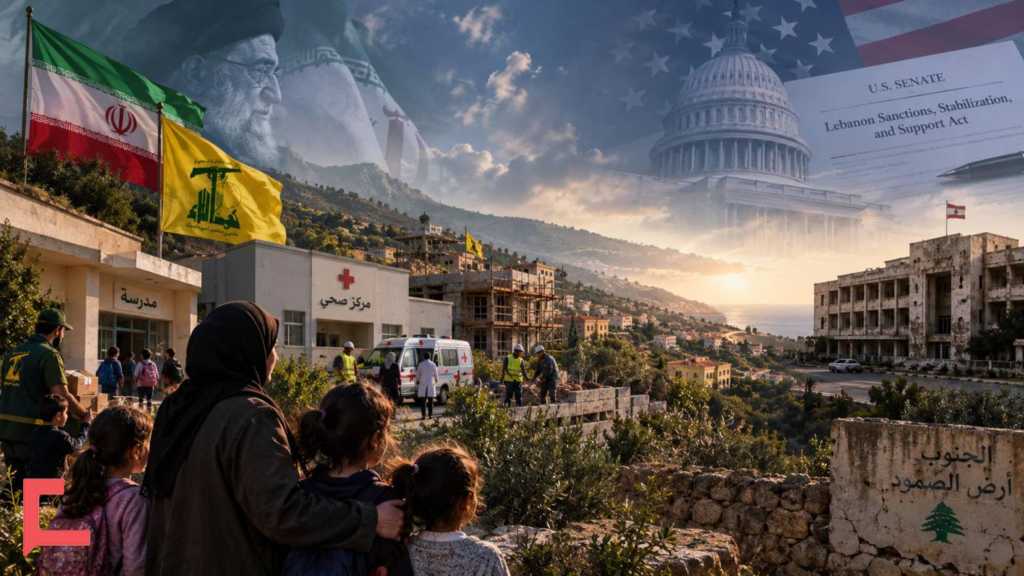
A proposal introduced in the United States Senate with the explicit objective of disarming Hezbollah contains an inadvertent admission about why the movement remains so deeply rooted in Lebanese society. Introduced in August 2026 as the Lebanon Sanctions, Stabilization, and Support Act, the legislation approaches Hezbollah not merely as a proxy army that can be eliminated through sanctions, but as a socio-political reality embedded in daily life. According to the office of Republican Senator James Lankford, the bill combines economic sanctions with state-run infrastructure recovery, security funding, and civil service expansion explicitly designed to provide Lebanese communities with an alternative to Hezbollah. By attempting to substitute state institutions for Hezbollah’s social network, Washington makes an important admission: Hezbollah's influence cannot be explained solely by Iranian military funding or domestic intimidation, as its opponents have often claimed.
More Than Services: Conviction and Resistance
This legislative prescription exposes a fundamental miscalculation by Washington strategists regarding the constituency in southern Lebanon. For decades, southern communities endured "Israeli" occupation, repeated military aggression, destroyed infrastructure, and systemic economic marginalization. The central government consistently abandoned these populations, creating a governance vacuum that Hezbollah stepped in to fill through hospitals, schools, and reconstruction networks. Yet, treating these communities as passive consumers whose allegiance can be purchased through civic aid reflects a deep misunderstanding of their political consciousness. The local relationship with Hezbollah was forged through decades of Resistance, invasion, and shared sacrifice. For many supporters, defending their land against "Israel" and preserving their national dignity are matters of faith, identity, and political conviction that cannot be traded away for state-issued social services. Replacing a Hezbollah-supported service with a government service may address material dependence, but it cannot simply replace convictions rooted in religious belief, historical experience, and decades of conflict. A community’s relationship with Resistance, therefore, cannot be understood as a mere transaction.
The Contradiction at the Heart of the Bill
The bill relies on a profound logical contradiction at the center of American policy toward Lebanon. The legislation seeks to expand state services to draw populations away from Hezbollah, while simultaneously utilizing security assistance to force those same state institutions into disarming the movement. In using public development as a strategic weapon, Washington implicitly admits the historical failure of the Lebanese state itself. The bill acknowledges that the government's long-standing abandonment of its citizens created the exact vacuum that enabled Hezbollah to build its legitimate social base. The central irony of the American proposal is that its strategy for weakening the Resistance begins by validating the very historical abandonment that made the Resistance necessary in the first place.
Instrumentalized Sovereignty and Geopolitical Aims
Furthermore, the bill reveals that Washington views the Lebanese government's return to these communities not as a duty owed to neglected citizens, but as a tool to advance Western geopolitical interests. Senator Lankford’s official release clarifies that the bill conditions aid on mandatory reporting regarding military coordination between the Lebanese Armed Forces and "Israel," alongside efforts to push Lebanon toward peaceful relations with its neighbor. Washington frames this as an effort to restore Lebanese sovereignty, yet it imposes strict foreign diplomatic expectations on state aid. The expanded government presence envisioned by American lawmakers is far from a neutral public service; it is a policy designed to turn the state against its own people to satisfy Western regional security goals.
The Miscalculation of Western Strategy
Ultimately, the expansive scope of the proposed legislation highlights the limitations of American strategy in the Middle East. If Hezbollah were merely an isolated militia sustained entirely by foreign weapons and illicit financing, dismantling it would not require comprehensive state reconstruction, civil infrastructure funding, and economic intervention. By treating civic development as an essential tool of disarmament, American policymakers unintentionally prove that Hezbollah's endurance is anchored in deep socio-historical roots. Western strategy may succeed in replacing a local service provider, but substituting a deeply rooted political conviction is an entirely different matter.