“Israeli” Assessments of the War’s Results: Where Is the Way Out of the “Strategic Predicament”?
Al-Akhbar Newspaper
Three years of war have failed to pull “Israel” out of the predicament exposed by the “Al-Aqsa Flood” operation, just as the consequences of the killing and destruction have failed to erase questions of failure and accountability.
On the third anniversary of October 7, these questions resurfaced in the “Israeli” streets and media, amid accusations that Prime Minister Benjamin Netanyahu has subordinated the conduct of the war and the lives of “Israeli” captives to calculations aimed at preserving his political survival, while he once again pledged to “complete the mission.”
Assessments by “Israeli” analysts and observers on the anniversary highlighted the widening gap between the scale of force employed and the war’s strategic results, amid the continued presence of “Israel’s” enemies in Gaza, Lebanon, Yemen, Iraq and Iran, mounting economic burdens, and the inability to restore public trust in the institutions of the “Israeli” state.
Security preparations ahead of the anniversary reflected the enemy’s continued fear of another attack. Maariv military correspondent Avi Ashkenazi reported that senior officials were taking into account the possibility that “Israel” could come under attack by “Hamas,” “Hezbollah” or Iran, despite the absence of any specific warning. In this context, “Israeli” army Chief of Staff Eyal
Zamir decided to conduct a surprise home-front drill, while an assessment meeting was held with the participation of Police Commissioner Danny Levy and Shin Bet chief David Zini. The meeting addressed intelligence assessments, defensive preparations and measures to secure the upcoming elections.
This came as protesters gathered outside the homes of ministers and read out the names of captives killed in the war, holding officials responsible for the consequences of the failure on October 7. Yedioth Ahronoth reported that two people were arrested outside Netanyahu’s home in Caesarea while participating in a demonstration demanding an investigation into the events of that day, for which Netanyahu continues to refuse to establish a commission- a matter also addressed in a Haaretz cartoon.
Meanwhile, National Security Minister Itamar Ben-Gvir used the anniversary to incite an expansion of the aggression in the West Bank. In a recording made near Tulkarm, he referred to the time the attack began- 6:29 a.m.- saying that “Israel” must not wait for another October 7 to happen. He added: “We need to dismantle the Palestinian Authority and strip it of its weapons,” and “When we face a threat, we do not wait. We act before it is too late.”
As for the opposition, its criticism of the government did not go beyond competing with it in calling for further aggression. This was evident, for example, in a statement by Avigdor Lieberman outside the Kerem Shalom crossing, where he accused the government of continuing to “fund Hamas” by allowing goods to enter the Gaza Strip for its residents. While at the site of the Nova festival in Re’im, Lieberman asked: “Now three years have passed. Where is the victory? Where is the change in approach?” He called for the complete occupation of the Strip and the elimination of the movement, as well as an agreement in advance on the party that would assume responsibility for administering the situation there. Netanyahu, for his part, reiterated his pledge to continue the war, saying: “We will complete the mission and hold accountable everyone who took part in the October 7 attacks.”
The killing and destruction failed to pull “Israel” out of its predicament
Yet “Israeli” assessments once again exposed the limits of the power on which the enemy’s leaders are relying. Haaretz military analyst Amos Harel wrote that, following the October 7 attack, “Israel” entered “a war that has not been decided and has not ended on any front,” and that the intensity of the strikes it launched against its enemies had failed to pull it out of its “strategic predicament.”
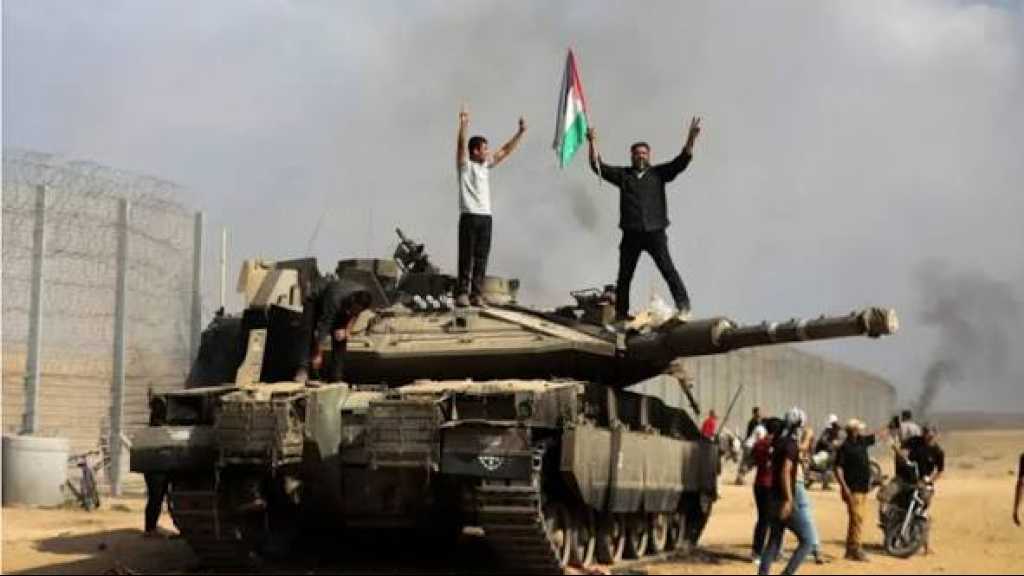
Harel returned to the years preceding the operation, recalling that the group led by Hamas commanders Yahya Sinwar and Mohammed Deif had prepared ten versions of the operational plan between 2016 and 2021, six of which reached the “Israeli” Military Intelligence Directorate. Nevertheless, the occupation army, which had dubbed the plan “Jericho Wall,” failed to take sufficient measures to prevent its implementation.
The writer attributed the failure to intelligence agencies’ underestimation of Hamas’s capabilities and seriousness, as well as their confidence that “technological and intelligence superiority would ensure advance warning.” But resistance fighters breached the wall at more than 100 points on the morning of the operation, within a period of between 15 and 30 minutes, and achieved a numerical advantage at several locations of seven or eight to one. While occupation forces were occupied defending their positions, ambushes prevented reinforcements from reaching them via the main roads.
A Golani Brigade officer, whose testimony Harel cited, summed up the collapse by saying that what happened “was not merely an intelligence or operational failure, but a failure of understanding.” The accumulated information had failed to prompt the military establishment to reassess its perceptions of Hamas. Even after the attack began, it was slow to grasp its scale and to implement the scenarios for which it had trained.
Colonel Ido Katz, who led the enemy army’s investigation into the battle at the Nahal Oz military base, said that despite having served for 18 years in the naval commandos, he may never have encountered an operational file comparable to Hamas’s plans to seize the base in terms of scope and depth. “They carried out a special intelligence operation against us,” he said.
Three years later, the “Israeli” military fortifications around and inside Gaza have not translated into a complete restoration of the confidence of residents of the nearby settlements in their army. According to Harel, the occupation forces established around 40 positions, most of them on hills located roughly one kilometer inside the Strip. While the heads of the regional councils in the Gaza envelope said that around 90% of residents had returned to their homes, the return and reconstruction have not erased the experience of “waiting for many hours without assistance.”
Comments