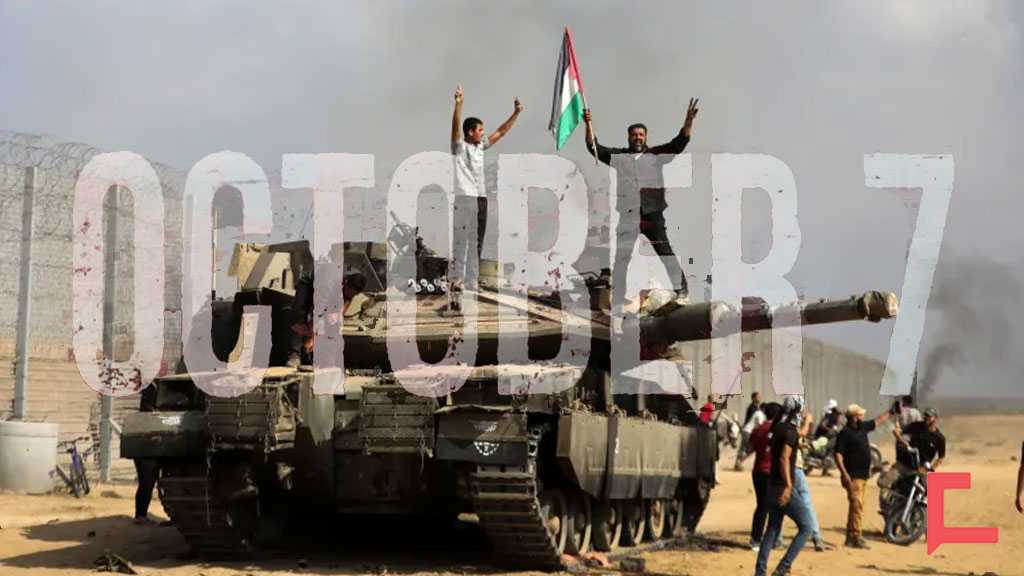
October 7: The Day the World Was Exposed to Its Own Reality
By Mohamad Hammoud
How Gaza stripped away the masks of Western human rights, Muslim solidarity and international justice.
October 7, 2023, unleashed a political tsunami whose waves traveled far beyond Gaza. It did not create the world’s contradictions; it exposed them, forcing nations, institutions, and citizens to reveal their true positions. From the collapse of Western human rights rhetoric to the quiet complicity of Muslim-majority governments and selective international justice, Gaza exposed a world where actions repeatedly contradicted declarations. Gaza became more than a battlefield. It became a mirror reflecting the world’s political reality.
“Israel’s” Military Strategy and Destruction
The devastation exposed an “Israeli” strategy that appeared to have been awaiting an opportunity to carry out genocide and drive Palestinians from their land. According to Palestinian health authorities, more than 73,000 people have been killed in Gaza since October 2023, including thousands of children. Entire neighborhoods were reduced to rubble, hospitals devastated, and families repeatedly displaced. Reports of torture, starvation, and attacks on civilian infrastructure raised profound questions about civilian protection. Meanwhile, settlement expansion, annexation rhetoric, and proposals for Palestinian displacement intensified scrutiny of the Greater “Israel” ideology and Palestinian sovereignty.
Western Complicity and Rhetoric
The destruction exposed the double standards underlying Western governments’ professed commitment to universal human rights. As Palestinian civilian casualties mounted, Washington continued supplying “Israel” with weapons and diplomatic protection, while several European governments condemned the humanitarian catastrophe without severing military or commercial ties. Governments routinely invoking international law and civilian protection continued policies sustaining their relationship with the very government accused of violating those principles.
That hypocrisy became more apparent in November 2024, when the International Criminal Court issued arrest warrants against Benjamin Netanyahu and former War Minister Yoav Gallant for alleged war crimes and crimes against humanity. Rather than producing unified support for international justice, the warrants exposed Western divisions over whether accountability should apply equally to allies and adversaries. If international law is universal, why should its enforcement depend on political alliances?
The Contradictions of Muslim Solidarity
Saudi Arabia repeatedly affirmed Palestinian rights, yet its response remained largely diplomatic. Religious authorities aligned with the Saudi government criticized armed Palestinian resistance, arguing that declaring jihad required legitimate political authority. Critics contrasted this with religious rulings supporting armed campaigns in Syria and against Yemen’s Ansarullah, which attacked “Israeli” targets in declared solidarity with Palestinians. Why was armed solidarity with Gaza restricted while military action against other Muslim groups received religious justification?
Turkey presented another contradiction. President Recep Tayyip Erdogan repeatedly denounced “Israeli” operations and imposed trade restrictions, yet Azerbaijani oil continued reaching “Israel” through Turkey’s Ceyhan terminal, fueling the very tanks and jets active in Gaza.
The United Arab Emirates offered an especially striking comparison. Despite condemning civilian suffering, Abu Dhabi maintained diplomatic and economic ties with “Israel.” According to the UAE Foreign Ministry, bilateral merchandise trade reached $3.2 billion in 2025, while the country continued expanding its relationship with “Israel.”
Pakistan likewise expressed solidarity with Palestinians through diplomatic statements and humanitarian assistance but avoided military confrontation with “Israel,” exposing the distance between its declarations and actions.
Yemen and the Question of Priorities
These contradictions intensified in October 2026, when Saudi Arabia, Turkey and Pakistan activated mutual-defense arrangements amid escalating fighting involving Yemen’s Ansarullah. According to Reuters, Turkey provided defensive and technical assistance, while Pakistan expanded military cooperation with Riyadh.
Ansarullah attacked “ai” targets and commercial shipping while declaring solidarity with Gaza. The emerging regional alignment raised questions about these governments’ priorities: governments unwilling to confront “Israel” militarily were coordinating military resources against an adversary presenting its operations as support for Palestine.
The Contrast of Global Solidarity
While traditional regional powers retreated into quiet diplomacy, nations outside the core Islamic world took decisive legal and political action against “Israel.” South Africa filed a genocide case at the International Court of Justice, while Spain and Ireland formally recognized Palestinian statehood and pushed for trade restrictions. Meanwhile, millions marched from London and Washington to Tokyo and Amman, highlighting the growing divide between ruling political elites and the moral demands of the public.
The Final Exposure
October 7 exposed neither one civilization nor one religion. It exposed the profound divide between proclaimed principles and political actions.
The tragedy was Palestinian. The reckoning was global.