Gaza’s Prosthetics Crisis Mounts: Growing Children, Missing Limbs
Edited by Staff, Al-Mayadeen
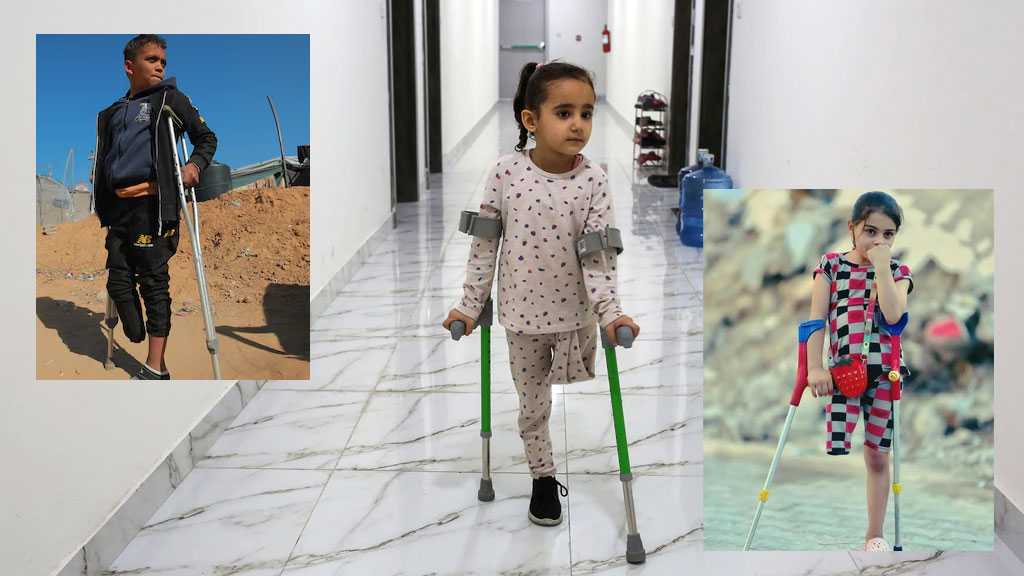
Thousands of children in Gaza are living with amputations, yet “Israeli” restrictions on medical supplies and barriers to evacuation leave many without suitable prosthetics, surgery, or rehabilitation. In a report for Mondoweiss, contributor Mohanad Al-Hemrawi documents the struggles of two young boys facing painful recoveries and uncertain access to treatment.
Eleven-year-old Abdul-Rahman Al-Nashash struggles to fit his left leg into a plastic prosthesis that has become too small.
Since his amputation two years ago, the bone in his remaining limb has continued to grow, pushing painfully against his skin.
Doctors have advised him to stop using the prosthesis, but he insists on wearing it each morning. He tightens the straps, covers the plastic with his trousers, and tries to conceal his limp as he takes his first steps of the day.
“He forces himself to wear it,” his mother said, explaining that he does so because he does not want others to know he has a disability.
Before the war, Al-Nashash played football for a local club, running across a dirt pitch until sunset. As the eldest son, he also helped his mother with household tasks, including carrying heavy containers of water. Those responsibilities have become impossible for him.
After removing his prosthesis, he sits hunched over, waiting for a third operation. According to his mother, he may require surgery every year as his body continues to grow.
Children who undergo amputations face a recurring medical challenge: their bones continue developing, but their prosthetic limbs do not grow with them. When the remaining bone becomes too long, the child may need corrective surgery before another prosthesis can be fitted.
In Gaza, where “Israeli” restrictions have limited access to the components and materials required to manufacture and repair artificial limbs, obtaining appropriate replacements has become increasingly difficult. Some children have outgrown their existing prostheses and cannot obtain new ones, while others have never received a suitable limb.
Al-Nashash’s ordeal began after his family fled the Bureij refugee camp in central Gaza in 2023, seeking shelter in schools run by the United Nations Relief and Works Agency for Palestine Refugees [UNRWA]. His father remained behind. On October 20, two days after the family left, an “Israeli” aggression targeted their home, killing him and several other relatives. The family’s only source of income, a three-wheeled motorcycle kept in a storeroom, was also destroyed.
The family subsequently moved between schools and tents, spending approximately three months in Rafah before relocating to schools in al-Nuseirat. With no regular income, Al-Nashash’s mother established a small business with her brother-in-law, selling canned beans.
On July 16, 2024, she left her son to look after the stall while she went to help her sister prepare a meal. Around noon, an “Israeli” airstrike targeted tents inside al-Razi School, an UNRWA shelter in Nuseirat refugee camp. Gaza’s Government Media Office reported that 23 people were killed.
An “Israeli” shrapnel fragment pierced Al-Nashash’s leg, leaving his left foot severely damaged, with exposed bones in his toes. His mother recalled screaming in fear that her son had died.
At first, she was told that doctors might save the leg by inserting metal plates. But at Al-Aqsa Hospital, a physician informed her that amputation was necessary. Desperate to spare her child, she offered to have her own leg removed and given to him, explaining that he had always been the one caring for her.
Al-Nashash was transferred by ambulance to a hospital near the sea in Deir Al-Balah, where an international medical team was working. Doctors determined that the limb could not be saved. His mother ultimately signed the consent form for the amputation, saying she had no alternative.
When he regained consciousness, he stared at his body in shock. His adjustment began gradually after counselors visited him and he met other children who had also lost limbs.
Local rehabilitation teams subsequently provided regular therapy. But his rapid growth soon created another obstacle. By March 2025, only eight months after the amputation, the remaining bone had already grown excessively long.
His family traveled to Jordan, where surgeons shortened the bone and fitted him with his first prosthesis. The stay lasted five months. Upon returning to Gaza, Al-Nashash had to relearn how to balance and walk through physical therapy, beginning the process almost from the beginning.
He now faces another operation, followed by an expected three months of rehabilitation before he can start learning to walk again. His mother has requested his medical evacuation from Gaza in the hope that he can receive treatment abroad.
“I wish I could see my son walk like other children,” she told Mondoweiss.
While waiting, he relies on forearm crutches whose handgrips have deteriorated. The cushioning has worn away, leaving his hands in direct contact with the hard surface.
“There are no spare parts for the grips,” his mother stressed.
A child left without a prosthetic
Ten-year-old Mahmoud Al-Darbali lost his right leg up to the hip when he was nine. More than a year later, he is still waiting for his first artificial limb.
His family’s home near Gaza City’s Zeitoun car market was bombed a week after they evacuated. After being forcibly displaced to southern Gaza more than 10 times, they returned north and crowded into one room in his grandmother’s house on Kishko Street in Zeitoun.
“We were happy,” his mother told Mondoweiss.
That fragile sense of relief ended on July 5, 2025, when three “Israeli” shells targeted the house. Several family members died, including Mahmoud’s 14-year-old sister.
“I didn’t get to say goodbye. She died hungry,” his mother said.
The blast severed Mahmoud’s right leg and burned his left thigh. Shrapnel wounded his seven-year-old brother’s lung and struck his mother’s knee. His 16-year-old brother was left with shrapnel near his spine and continues to suffer pain that prevents him from sleeping without medication.
Mahmoud spent more than two months at Al-Ahli Arab Maamadani Hospital, where he underwent daily procedures to change his bandages. His mother and her five surviving children shared a single hospital bed.
During the same month, Doctors Without Borders [MSF] reported that injured people receiving care at its clinics in Gaza were asking for food instead of medicine. Without sufficient protein, patients’ wounds were barely healing.
Following his discharge, the family was forced to live on the street. Mahmoud uses crutches and a wheelchair, but he cannot travel more than 100 meters on crutches. Frequent power cuts leave him struggling to maintain his balance in the dark.
“Many times, I wake up to his terrified voice as he hits the ground,” his mother said.
He also experiences pain in the missing limb, a phenomenon known as phantom limb pain. His mother said he sometimes complains that his heel hurts, while his brother presses against the empty space where the leg used to be. The gesture brings him some relief, Mahmoud tells his family.
He has received no psychological support. When given paper to draw on, he depicts tanks, missiles, and blood.
Because the amputation extends to his pelvis, leaving very little of the thigh bone, his family has been told that no prosthesis currently available in Gaza can fit him. Although he has been referred for treatment abroad, no country has yet accepted his case.
“The situation is hard,” his mother said. “And there is no food.”
Dr. Mohammed Abu Mansi, a specialist in physical therapy and rehabilitation at Sheikh Hamad Bin Khalifa Al Thani Hospital for Rehabilitation and Prosthetics in Gaza City, said bone overgrowth does not mean every child requires surgery annually. However, in some cases, the growing bone creates a protrusion that makes wearing an artificial limb extremely painful.
“When the child puts weight on the prosthetic, this spot becomes very painful,” he explained. “The pressure inside the prosthetic becomes unbearable.”
Corrective operations can be performed in Gaza, Abu Mansi said, depending on the availability of operating rooms, anesthesia, and post-operative care. More complicated cases require treatment outside the territory.
Access to manufacturing materials is a major obstacle
For children with amputations extending to the hip, access to manufacturing materials is a major obstacle.
“We used to fit this type of prosthetic inside Gaza before the war,” Abu Mansi told Mondoweiss. “But now the materials needed to make a prosthetic for an amputation up to the hip are not available.”
Before the war, supplies arrived regularly, enabling the hospital to provide consistent prosthetic services. Their absence has left children such as Al-Darbali without appropriate artificial limbs.
Abu Mansi warned that prolonged dependence on crutches and wheelchairs can lead to muscle weakness, contractures, restricted mobility, and changes in the shape of the remaining limb as children grow.
The two boys are among thousands of people in Gaza living with amputations. The World Health Organization [WHO] estimates that more than 5,000 people have lost limbs in the territory since October 2023, with children accounting for one in five cases.
Between September 2024 and May 2026, the WHO assessed 2,277 amputees. Only 502 had received prosthetic limbs. Children represented 18% of those assessed, while 32% had undergone amputations above the knee. A total of 225 people required corrective surgery on their remaining limbs, and only eight prosthetists were working across Gaza.
The WHO also reported that no rehabilitation equipment entered Gaza between May 2024 and April 14, 2026. By that date, 18 shipments containing items such as prosthetic limbs and wheelchairs for children remained awaiting clearance. The shipments had been delayed for an average of 136 days, with the longest wait reaching 526 days. Four additional shipments had been rejected during the preceding six months.
In June, the UN Office for the Coordination of Humanitarian Affairs reported that “Israeli” authorities had refused requests to bring in prosthetic hands, knee and ankle joints, silicone liners, and specialized medical footwear.
Access to treatment outside Gaza remains uncertain even when patients receive medical referrals. A receiving country must first agree to take a patient, after which the case is submitted to “Israeli” authorities for clearance.
By mid-September, 13,555 patients, including 6,326 children, had been evacuated from Gaza since October 2023. Before the war, between 50 and 100 patients left the territory daily to obtain medical care.
In January, WHO Director-General Tedros Adhanom Ghebreyesus said that more than 18,500 patients, among them 4,000 children, still required urgent evacuation. Citing Gaza’s Ministry of Health, he added that 1,092 patients had died while awaiting evacuation between July 2024 and November 2025.
‘They’ll cut off my other leg’
Al-Darbali turned 10 in July. His mother continues to wait for officials handling his referral to tell her that he can leave Gaza for treatment.
“Every second, I pray my phone will ring, and they’ll tell me to get ready,” she said.
Hospital visits have become frightening for the boy. He now refuses to be put under anesthesia, fearing another amputation. His remaining left leg still bears the scars of the burns he suffered in the “Israeli” aggression.
“I don’t want to sleep,” Mahmoud said. “They’ll cut off my other leg.”
“Israeli” restrictions on medical evacuations are not only a crisis for amputees in Gaza but also for cancer patients and thousands of others who cannot access specialized treatment outside the besieged enclave. With the Rafah crossing closed to medical evacuations for more than two weeks, critically ill Palestinians remain stranded as their conditions deteriorate.
Mohammed Abu Afash, director of Medical Relief in Gaza, told The New Arab that 2,027 patients had died while awaiting treatment and evacuation since October 2023. More than 21,000 patients require medical evacuation, including people with cancer, kidney failure, heart disease, and other conditions requiring specialized care unavailable in Gaza.
Gaza’s Ministry of Health warned that evacuating those currently on waiting lists could take four years under the existing system, potentially extending to eight years as new referrals continue to accumulate. Meanwhile, shortages of medicines, medical supplies, and diagnostic services have further weakened a healthcare system in which only 227 of more than 574 healthcare centers operating before the war remain functional.
In short, the restrictions affect war survivors who require specialized treatment abroad, highlighting the growing risks facing thousands of Palestinians who remain unable to access potentially life-saving care through medical evacuations.
Comments