- Home
- ISLAMIC RESISTANCE
- SECRETARY-GENERAL
-
Full Speeches
- Speeches-2000
- Speeches-2006
- Speeches-2007
- Speeches-2008
- Speeches-2009
- Speeches-2010
- Speeches-2011
- Speeches-2012
- Speeches-2013
- Speeches-2014
- Speeches-2015
- Speeches-2016
- Speeches-2017
- Speeches-2018
- Speeches-2019
- Speeches-2020
- Speeches-2021
- Speeches-2022
- Speeches-2023
- Speeches-2024
- Speeches-2025
- Speeches-2026
- Speech-Reports
- SG
-
Full Speeches
- Voices
- Ten Day Dawn
- The Biggest Crime
- Martyr Leaders

Spain’s High-Speed Rail Network Faces Safety Scrutiny After Deadly Collision
By Staff, Agencies
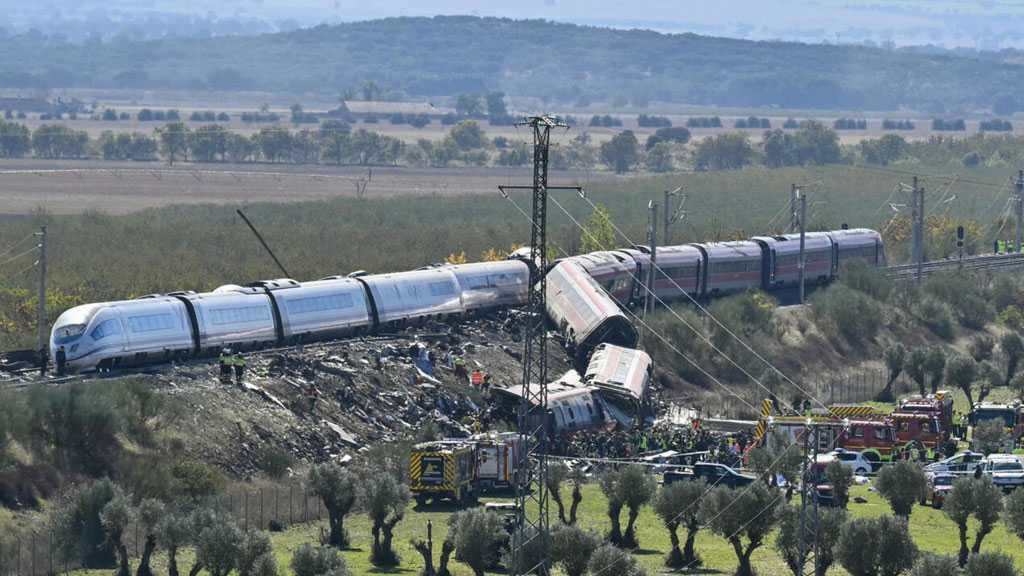
Spain’s high-speed rail network is facing renewed scrutiny following a deadly train collision that killed at least 68 people and injured dozens on Wednesday, as leaked audio recordings raised questions about the handling of a malfunctioning safety system before the crash.
According to audio recordings obtained by Spanish broadcaster RTVE, controllers at state rail manager Adif instructed the driver of a train to disconnect the malfunctioning LZB safety system and resume the journey at speeds of up to 200 kilometers per hour.
“Disconnect and reconnect the LZB and resume journey under the protection of the BSL at normal speed,” controllers told the driver at 8:36 a.m. local time.
Minutes later, the driver of the Iryo train reported that he could not continue moving.
“I've had a loss of transmission and I'm stopped at the Urda entrance signal,” the driver said.
While the government has pointed to possible human error in allowing a train to enter an occupied track, RTVE, citing sources, challenged the reported sequence of events, saying the Iryo train had not received clearance to move before the collision.
The crash occurred in central Spain, approximately 140 kilometers [87 miles] south of Madrid, between Mora and Orgaz. A train traveling from Madrid to Seville struck the stationary Iryo train, sending several carriages down an embankment.
The Iryo train, which was carrying 147 passengers, had stopped on the tracks because of a computer system failure.
Transport Minister Oscar Puente identified technical failure and human error as possible contributing factors, as investigators work to establish the circumstances surrounding the disaster.
Survivors described scenes of chaos and devastation, recounting how passengers were thrown through the air, trapped inside wreckage, and forced to break windows to escape.
The tragedy has renewed concerns over the safety infrastructure of Spain’s Madrid-Seville high-speed rail line, which opened in 1992 and continues to rely on the older LZB signaling system rather than the more modern European Rail Traffic Management System [ERTMS].
The collision is the second fatal accident on the line in nine months, following a January crash near Córdoba that killed 46 people.
The investigation is expected to focus on the sequence of communications between railway controllers and train drivers, the malfunctioning safety equipment and whether established operating procedures were followed before the collision.
Comments
- Related News