This Is How the Military Governor Was Greeted by Ahmad Qasir
By Minhal Al-Amin
A construction worker came running, holding that day’s newspaper, dated 10 November 1982. He arrived at the workshop breathless, trying to catch his breath, eager to share some distressing news with his colleagues.
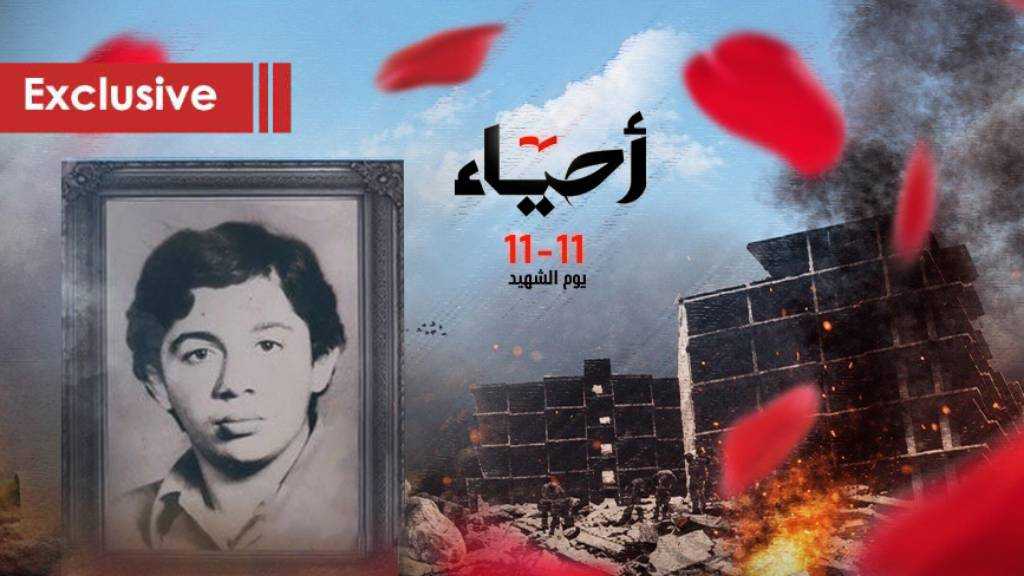
It was a small classified advertisement tucked into the corner of one of the newspaper pages. Ahmad Jaafar Qasir [20]. Beside the name was a photograph of a dark-complexioned young man, his thick, abundant hair neatly combed to the right. His expression was neutral, neither sad nor happy, like any photograph taken for an official document.
Beneath the photograph was the following announcement:
“He left his parents’ home and has not returned since Thursday, 4 October. Anyone with information about him is kindly requested to call either of the following two numbers: 7/353106.”
Look closely at the photograph. It was an old picture, quite different from the features of the young Lebanese man who had worked with them for some time as a plumber. The plumbing technician, who had recently arrived from Lebanon in Saudi Arabia, had been taking a lunch break with them on 6 June of that year when footage appeared on the television showing the “Israeli” occupation forces invading Lebanon: scenes of bombardment, destruction, massacres, and tanks crushing everything in their path.
He struck the table with his hand and vowed: “You will see what we are going to do to them.”
Poor Ahmad. He had returned to Lebanon to liberate his land, only to be swallowed up by the civil war. He joined the ranks of thousands of people who had gone missing or been forcibly disappeared.
When Ahmad made that vow against the enemy in their presence, they perhaps felt sympathy and pity for him. After all, the 19-year-old had no idea what he might actually do. He was still at the threshold of adulthood and had never carried a weapon or belonged to any political party. All he knew of revolution and Resistance had found its way into his heart through broadcasts from Tehran, Palestine, and Lebanon, where the Palestinian revolution had established its presence. Now, the invasion had brought him face to face with a bitter reality, thrusting him into its very heart.
He had emigrated with his family to Libya when he was eight years old. Then, in 1981, he moved with his father and brother Musa to Saudi Arabia, where he took up plumbing, repairing household water and sanitation systems. Before long, he had become a skilled tradesman in his profession.
He had spent most of his short life away from home. Yet the invasion stirred within him all the longing and yearning for his homeland, awakening an overwhelming desire to retaliate against the aggression and lift the injustice and oppression inflicted upon his people. It was as though he were saying, in a blend of Levantine and North African dialects: “They wish! They won’t enjoy our land while we’re gone.”
In August of that same year, he made his way back home, to occupied territory and all the way to its capital, Beirut. With the occupation forces having expanded their control from the south into central Lebanon, parts of the mountain region, and the Bekaa Valley, the first Resistance fighters, following the confrontations in Khaldeh, began preparing for a prolonged occupation.
The immediate priority was to transport weapons to the front lines, particularly as the “Israeli” forces had begun withdrawing, first from Beirut and later from Sidon, eventually retreating to what became known as the occupied strip after 1985.
During this period, Islamist Resistance fighters carried out a series of operations of various kinds, targeting “Israeli” soldiers in military vehicles, on buses transporting them from Palestine to Lebanon or between different Lebanese areas. These attacks involved explosive devices, sniping, grenade attacks, and other methods.
As the country was being torn apart, ravaged by internal wars and manipulated by the geopolitical games of foreign powers, the group that had gradually taken shape through several emerging cells here and there kept itself apart from all of this. Its focus remained firmly on confronting the enemy that was on the verge of devouring the country. Ahmad found in this group the purpose he had been seeking. He took part in transporting weapons and preparing for the earliest rudimentary operations against the occupation forces throughout southern Lebanon.
Islamic activism accompanied and guided these early pioneers through a group of religious scholars and cadres with previous experience in national political parties, Palestinian factions, and various Islamic organizations, including the Islamic Dawa Party and the Muslim Students’ Union, among others. The mosque was the starting point, a platform for raising awareness, and a sanctuary for spiritual closeness and growth.
Just as Resistance work had provided Ahmad with a way to fulfil his vow to confront the occupation, the mosque became his refuge and solace. Within its walls, he nurtured his spiritual self, preparing it for the decisive tasks that lay ahead. It was also there that he forged friendships with peers who shared his concerns and ambitions.
But Ahmad took things a step further, in a way no one had before.
“What would it take to strike the military governor’s headquarters? A car bomb? How much explosive material would we need?”
He would ask these questions not because he expected answers, but to discover who among those he met along the way was prepared to join him on this difficult path.
And it was in the mosque that the essence of the idea took shape: Al-Fath [the opening]. He confided it to his close companion, Reda Hariri. Abdul Moneim Qasir was the third member of their group.
Reda and Ahmad worked together to reconnoiter the location. Ahmad also took advantage of his father’s fruit and vegetable business, volunteering to help the family and temporarily setting aside his main profession.
With every delivery of vegetables, he would travel from Deir Qanoun to the produce market in Tyre, taking the road through Abbassiyeh and passing the Jal al-Bahr area, where the enemy had seized the Azmi Building and turned it into the military governor’s headquarters.
He would observe the site repeatedly, coming and going at different times of the day, driving the white pickup truck he had bought in Saudi Arabia after selling his car and then driven overland all the way to Lebanon.
It was from this very headquarters that he had once been forced to obtain a permit to enter his hometown of Deir Qanoun al-Nahr. According to the martyr Abu al-Fadl Karaki, Ahmad harbored immense anger and a powerful desire for revenge against the enemy. He did not approach the “Israeli” authorities with the submissiveness of someone seeking permission. Instead, he confronted the “Israeli” officer, and a heated altercation broke out between them. By God’s will, it did not end with his arrest.
This was how Ahmad’s personal journey of jihad began. It lasted no more than three months, culminating in what Sayyed Hassan Nasrallah described as the most significant operation in the history of the struggle against the Zionist enemy.
On 19 May 1985, Ahmad Qasir’s name appeared in public for the second time, following the liberation of Deir Qanoun al-Nahr. But this time, he was no longer a missing person. He had become the one who opened a new chapter in the era of martyrdom-seeking operations.
That day, the young Hezbollah leader, Sayyed Hassan Nasrallah, stood at the pulpit of the Deir Qanoun al-Nahr Husayniyah and announced the party’s responsibility for the bombing of the military governor’s headquarters in Tyre. He declared that the operation had been carried out by a son of the town, Ahmad Jaafar Qasir.
He had left his parents’ home to dwell in the noblest of homes, on earth and in heaven.
We came to know some things about him, while so much else remained hidden from us.