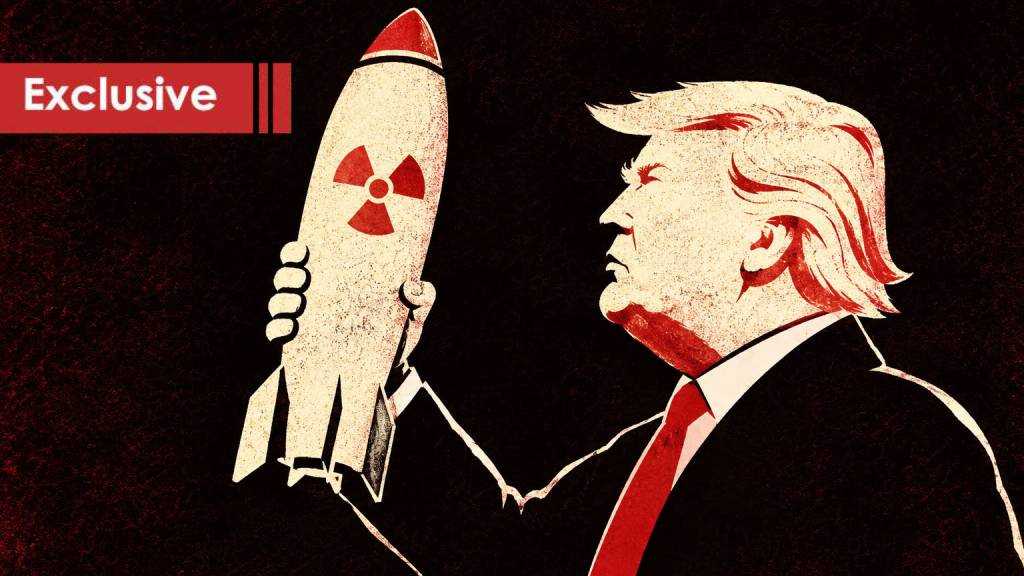
What If Trump Uses a Nuclear Bomb Against Iran?
By Mohamad Hammoud
The Nuclear Threshold
No country has used nuclear weapons in combat since the United States bombed Hiroshima and Nagasaki in 1945. Despite decades of wars and confrontations between nuclear powers, the fear of catastrophic consequences has helped preserve that restraint. Now, allegations that Donald Trump is being pressured to use a nuclear weapon against Iran raise the possibility of breaking this eight-decade taboo, with consequences extending far beyond Tehran and raising questions about Iranian retaliation, the security of Washington’s regional allies, and whether other nuclear powers would begin treating nuclear weapons as usable instruments of warfare.
Netanyahu’s Pressure and the Legal Question
On November 2, the “Jerusalem Post” reported that Tucker Carlson alleged Benjamin Netanyahu was pressuring Trump to use a nuclear weapon against Pickaxe Mountain, near Iran’s Natanz complex, because conventional bombs could not penetrate its underground defenses. Although Carlson’s allegations remain unverified and Trump has publicly rejected nuclear use against Iran, the possibility raises a consequential question: would American military commanders comply with such an order?
While Washington has no blanket no-first-use nuclear policy, military commanders are legally obligated to reject manifestly unlawful orders. Former US Strategic Command chief Robert Kehler addressed this principle during a 2017 Senate hearing, confirming that an illegal nuclear order could be refused. Whether a particular strike would violate international humanitarian law, however, would depend on military necessity, distinction, proportionality, and foreseeable civilian harm. Military resistance therefore remains legally possible, though far from guaranteed.
Iran’s Response: From Dimona to the Gulf
Iran’s retaliation could have catastrophic consequences not only for the United States and its allies but also for the global economy. In April 2024, Reuters reported that an Iranian Revolutionary Guard commander warned that if “Israel” attacked Iran’s nuclear facilities, Tehran could retaliate against “Israeli” nuclear installations, including the Dimona complex, where damage to radioactive materials could contaminate surrounding areas.
Beyond nuclear facilities, Tehran could intensify missile and drone attacks against American military bases and strategic infrastructure across the Gulf, including energy terminals, ports, and transportation networks. Such attacks could further disrupt regional oil production and exports, while additional restrictions on shipping through the already partially closed Strait of Hormuz could deepen the disruption to global energy supplies.
Iran could also disrupt international communications by damaging undersea fiber-optic cables linking Asia, Europe, and Africa. Such an operation could interrupt internet connectivity, financial transactions, and international commerce, extending the economic consequences far beyond the Middle East.
Fallout Would Cross Borders
Beyond Iran’s retaliation, the nuclear strike itself could endanger Washington’s regional allies, as radioactive fallout would not necessarily remain within Iranian borders. Depending on the weapon’s explosive yield, detonation depth, and weather conditions, winds could carry radioactive particles into neighboring countries, contaminating farmland, water supplies, and populated areas.
The consequences could be especially severe for Gulf states, which depend heavily on desalination for drinking water. Radioactive contamination near seawater intake facilities, or precautionary shutdowns to prevent exposure, could threaten water security and disrupt essential services. Although the extent of contamination would depend on the strike’s location and prevailing weather, Washington could not guarantee that its allies would escape the environmental and humanitarian consequences.
A Dangerous Precedent for Nuclear Proliferation
Beyond the immediate destruction, an American nuclear strike could undermine decades of efforts to prevent nuclear proliferation. Rather than discouraging Iran from acquiring nuclear weapons, it could convince Tehran that only a nuclear deterrent could protect it from future attacks, while encouraging other non-nuclear states to reach the same conclusion.
The implications could also extend to existing nuclear powers. Russia could invoke Washington’s use of nuclear weapons to justify escalating its nuclear threats over Ukraine, while China, despite its declared no-first-use policy, could accelerate its nuclear buildup amid tensions over Taiwan. Although neither response would be inevitable, breaking the nuclear taboo could weaken the restraint that has helped prevent nuclear warfare since 1945.
A Weapon Without a Controllable Victory
Even if Washington possesses the military capability to launch a nuclear strike against Iran, it cannot guarantee control over the consequences. Rather than securing a decisive victory, such an attack could trigger regional retaliation, endanger American allies, and encourage other nuclear powers to follow its example. Whatever pressure Netanyahu may be exerting on Trump, as Carlson alleges, the United States would ultimately bear responsibility for unleashing a crisis it could neither contain nor easily reverse.
The question, therefore, is not whether Washington can use a nuclear weapon against Iran, but whether it can afford the consequences.
Comments