The Enemy’s Testimony: How Western and “Israeli” Voices Saw Sayyed Hassan Nasrallah
By Mohamad Hammoud
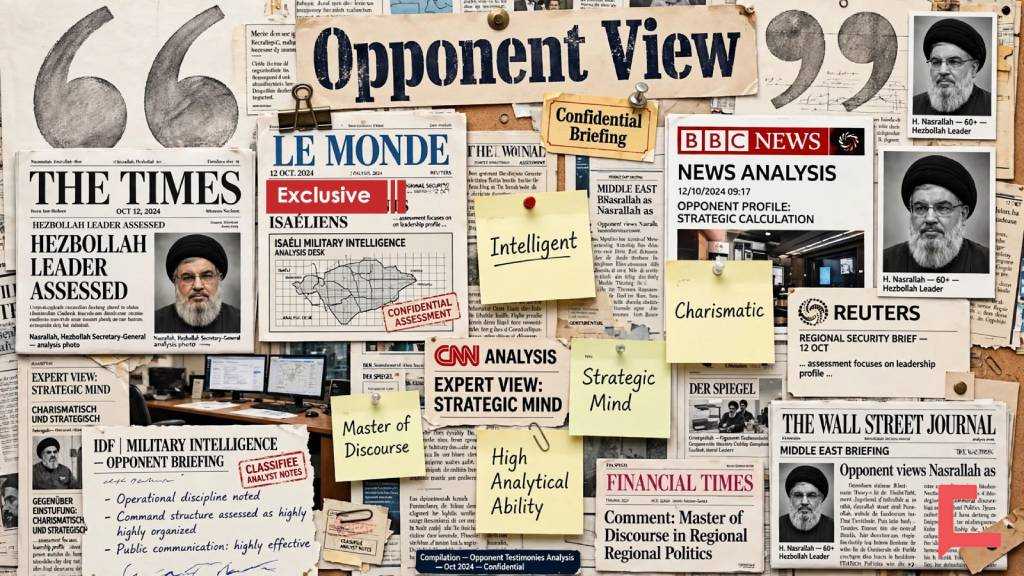
Few Middle Eastern leaders were studied by their adversaries as intensely as Sayyed Hassan Nasrallah. For decades, “Israeli” intelligence dissected his speeches, Western journalists interviewed him, and scholars examined his leadership. Their assessments were often hostile to his politics and organization. Yet beneath that hostility emerged an unusual consensus: Sayyed Nasrallah was intelligent, charismatic, strategically calculating, and exceptionally attentive to the psychology of his adversary.
Writing in The Washington Post during the 2006 Lebanon War, veteran correspondent Robin Wright described Sayyed Nasrallah as an “Islamic populist” and a “charismatic guerrilla tactician.” More striking was the judgment of Daniel Ayalon, then “Israel’s” ambassador to Washington, who called him “the shrewdest leader in the Arab world.”
A “Piercing Intelligence”
The recognition went beyond charisma. In a 2009 Foreign Policy essay, Washington Post columnist David Ignatius, who interviewed Sayyed Nasrallah in 2003 and 2006, called him “one of the Arab world’s most charismatic figures” and credited him with “a piercing intelligence.” Ignatius highlighted his pragmatism, noting that Sayyed Nasrallah could conduct indirect negotiations over prisoner exchanges.
“Israeli” commentary could be even more emphatic. In a 2004 Yedioth Ahronoth/Ynet column, Raanan Shaked portrayed Sayyed Nasrallah as exceptionally intelligent, knowledgeable, persuasive, and commanding on television, calling him a prodigy and writing that it was clear he was brilliant. The assessment was notable because it came from an “Israeli” commentator.
Through the Eyes of “Israeli” Intelligence
Perhaps the most revealing judgments came from professionals whose job was to understand him. In a 2022 "'Israel' Hayom" interview, Brig. Gen. Dror Shalom, former head of the IOF Military Intelligence Research Division, described Sayyed Nasrallah as an “extremely unique figure” with “developed thinking,” abundant charisma, and “high emotional intelligence.” Shalom said those qualities helped explain Hezbollah’s popularity and emphasized Sayyed Nasrallah’s ability to use the professional apparatus around him.
Shalom also credited Sayyed Nasrallah with an exceptional ability to analyze “Israel,” including its political nuances and public debates. His close attention to “Israeli” newspapers, television, political disputes, and public sentiment allowed him to turn his adversary’s information environment into a source of strategic knowledge. His words were therefore examined as carefully as his military decisions.
Shalom was not alone in that assessment. Former “Israeli” Military Intelligence analysis chief Itai Brun offered another professional assessment in a 2021 Jerusalem Post interview, describing Sayyed Nasrallah as increasingly careful, wary, and deliberate. Brun presented a leader capable of learning from experience, adjusting his conduct, and exercising restraint rather than acting impulsively. Alongside Shalom’s observations, it reinforced the image of a leader whose adversaries took his judgment and analytical abilities seriously.
Charisma as Strategic Power
Western scholarship likewise treated Sayyed Nasrallah’s personal authority as requiring serious explanation. In Hezbollah: Mobilization and Power, published by Oxford University Press in 2019, scholar Aurélie Daher devoted an entire chapter to “The Hassan Nasrallah Phenomenon: Leadership and Mobilization.” Oxford’s abstract says Sayyed Nasrallah’s personality and militant trajectory became a “major element” in Hezbollah’s attraction to militants and supporters. Daher examined his “mature yet still evolving charisma” and concluded that Sayyed Nasrallah had earned a place among the Arab world’s leading figures.
That judgment echoed what journalists, commentators, and intelligence officers had observed for years: Sayyed Nasrallah’s charisma was not merely ornamental. It functioned as political and strategic power. His command of language enabled him to move between religious discourse, military messaging, political argument, and everyday speech, often addressing supporters and adversaries simultaneously. Communication itself became part of how he exercised influence.
The Adversary’s Testimony
Taken together, these assessments reveal a striking consistency. Across Western journalism, “Israeli” commentary and military intelligence, and academic scholarship, Sayyed Nasrallah was repeatedly described as intelligent, charismatic, analytical, and deliberate—possessing “piercing intelligence,” “developed thinking,” and “high emotional intelligence,” and even called “the shrewdest leader in the Arab world.” These were not the words of Hezbollah’s media or Sayyed Nasrallah’s supporters, but of journalists, scholars, and adversaries who spent years studying him.
That is what gives their testimony its significance. Admiration from supporters is expected; acknowledgment from those who confronted him carries a different weight. On the anniversary of his martyrdom, their words leave a portrait drawn from across the divide: a leader whose intellect, charisma, strategic discipline, and commanding presence were too consequential for even his enemies to ignore.
Comments
The Most Honored Martyr in the Eyes of the Egyptians
11 hours ago
When the World Walked Out
one day ago